


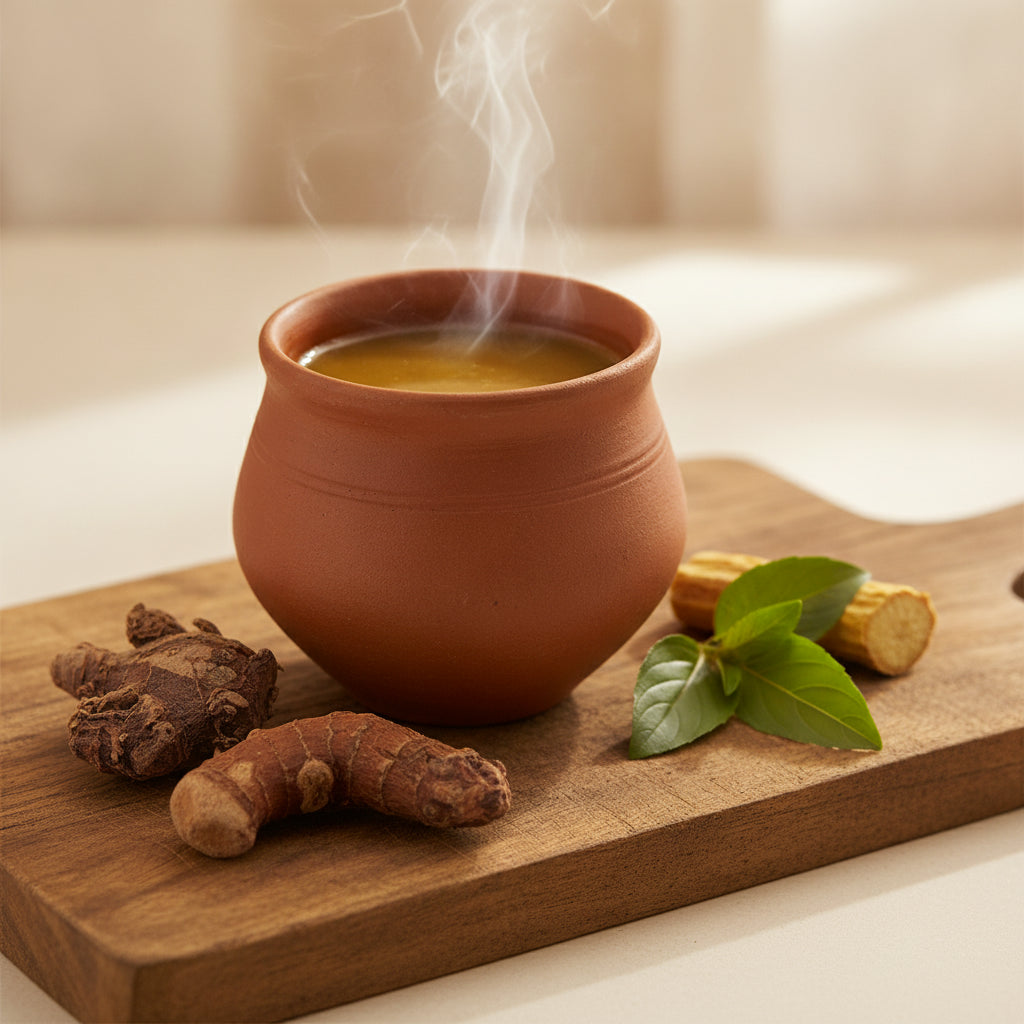
What is Paan ki Jad (Kulanjan)?
Paan ki Jad and Kulanjan are two names for the same herb: the underground stem (rhizome) of Alpinia galanga, a plant of the ginger family (Zingiberaceae). It is known in English as greater galangal, Siamese ginger or Thai ginger, and in Thai cooking as kha.
Why is it called "betel root"? "Paan ki Jad" and "betel root" are old trade names. Despite the name, Kulanjan does not come from the paan (betel leaf) vine, Piper betle. It is a separate, ginger-like plant. Pansaris across North India sell it as Paan ki Jad, Paan Jadd, Kulanjan or Kulinjan, and all of these refer to the same rhizome.
Names in other languages
| Language | Name |
|---|---|
| Hindi | पान की जड़ (Paan ki Jad, Pan ki Jad, Paan Jadd), कुलंजन / कुलिंजन (Kulanjan, Kulinjan) |
| English | Greater galangal, galangal root, Siamese ginger, Thai ginger; traded as "betel root" |
| Sanskrit / Ayurveda | कुलञ्जन (Kulanjana) |
| Marathi | कोळिंजन (Kolinjan) |
| Bengali | কুলঞ্জন (Kulanjan) |
| Tamil | பேரரத்தை (Perarathai) |
| Malayalam | അരത്ത (Aratta) |
| Thai | ข่า (Kha) |
| Botanical | Alpinia galanga (L.) Willd. (Zingiberaceae), rhizome |
How to identify genuine Paan ki Jad
- Shape: knobby, branched, finger-thick pieces, like dried ginger but harder and woodier.
- Surface: reddish-brown, with evenly spaced ring marks around each piece and tufts of dry rootlets.
- Inside: the cut ends are pale cream to light orange and fibrous.
- Smell: sharp, spicy and slightly camphor-like, especially when broken or scraped.
- Taste: pungent and warming, with a peppery-ginger bite when chewed.
- Watch out for: pieces that are light, crumbly, mouldy or smell of nothing, which means old stock.
Traditional uses
In Ayurvedic, Unani and household practice, Paan ki Jad (Kulanjan) has traditionally been used:
- For the throat and voice: a small piece is chewed slowly by singers, teachers and speakers. This is its best-known use.
- In seasonal home remedies: boiled into a warm kadha with tulsi, ginger and mulethi in cold weather.
- As a warming digestive: taken in small amounts after heavy meals.
- In cooking: used in Thai and Indonesian curries and soups, and in some biryani and garam masala blends.
These are traditional uses, not medical claims. Paan ki Jad is not a substitute for medicine.
How to use Paan ki Jad
- Chew: keep a small piece (about ½ inch) in the mouth and chew slowly, once or twice a day.
- Powder: ¼–½ teaspoon with a teaspoon of honey or in warm water, once a day.
- Kadha: boil 1–2 small pieces in 2 cups of water until reduced to 1 cup, strain and sip warm.
- Cooking: add a few thin slices to soups and curries, or grind a small piece into masala.
Raw or powder: which should you buy?
| Raw pieces | Powder (चूर्ण) | |
|---|---|---|
| Best for | Chewing, kadha, cooking | Quick daily use with honey or water |
| Aroma | Stays strong for longer | Released immediately |
| Identification | Easy to check it is genuine by sight and smell | Buy from a seller you trust |
Product details
| Product | Paan ki Jad | Betel Plant Root | पान की जड़ |
| Also known as | Kulanjan, Kulinjan, greater galangal |
| Botanical source | Alpinia galanga (greater galangal) |
| Part used | Rhizome (dried) |
| Pack size | 100g |
| Form | Raw (whole pieces) or Powder |
| Price | ₹320 per 100g |
| Ingredients | 100% Paan ki Jad (Kulanjan) |
| Storage | Airtight container, cool and dry place, away from sunlight |
| Sold by | Dhanyawad Ayurved Vatika, Sector 13, Dwarka, New Delhi |
| Delivery | Ships within 24 hours, delivered across India in 3–5 days |
Safety
Kulanjan is safe in the small amounts used in cooking and home remedies. It is warming (ushna), so large amounts may cause acidity or stomach irritation. Avoid medicinal amounts during pregnancy and breastfeeding, and consult a doctor or qualified Ayurvedic practitioner before regular use if you have a medical condition or take medication. Keep out of reach of children.
Frequently Asked Questions
Are Paan ki Jad and Kulanjan the same?
Yes. Paan ki Jad is the pansari trade name for Kulanjan (also spelled Kulinjan), the dried rhizome of greater galangal, Alpinia galanga.
What is Paan ki Jad called in English?
Greater galangal, or galangal root. It is also sold as "betel root", Siamese ginger or Thai ginger.
Does Paan ki Jad come from the paan (betel leaf) plant?
No. Despite the name, Paan ki Jad (Kulanjan) is the rhizome of Alpinia galanga, a ginger-family plant. The betel leaf vine is Piper betle, a different plant.
Paan ki Jad kaisi hoti hai? (What does it look like?)
It comes as knobby, reddish-brown, finger-thick pieces with evenly spaced ring marks and dry rootlets, pale and fibrous inside, with a sharp, spicy, camphor-like smell.
What are the benefits of Kulanjan? (Kulanjan ke fayde)
Kulanjan is traditionally chewed for throat and voice care, boiled into winter kadhas, taken as a warming digestive, and used in cooking. These are traditional uses, not proven medical benefits.
How do you use Paan ki Jad?
Chew a ½-inch piece slowly, take ¼–½ teaspoon of powder with honey or warm water once a day, or boil 1–2 pieces into a kadha.
How much does Paan ki Jad (Kulanjan) cost?
Dhanyawad Ayurved sells Paan ki Jad at ₹320 per 100g, as raw pieces or powder, with delivery across India.
Can Kulanjan be taken daily?
It is traditionally taken in small amounts. Because it is warming, avoid large amounts, avoid medicinal use during pregnancy and breastfeeding, and consult a doctor before regular use if you have a health condition.
Information reviewed by Vaidya Ravinder Arora (40+ years), Dhanyawad Ayurved Vatika, Dwarka, New Delhi. Traditional uses only; not medical advice.

VEGAN

NATURAL INGREDIENTS

CRUELTY FREE

Ethically Sourced

No Artificial Flavors

Made with Love
You may also like


Disclaimer: The information provided is for educational purposes only and is not intended to replace medical advice. Always consult a qualified Ayurvedic practitioner before using any herbal product for therapeutic use, as individual responses may vary based on one’s health condition, dosha constitution, and imbalances.

- Choosing a selection results in a full page refresh.
- Opens in a new window.
