
Paan ki Jad = Kulanjan = Galangal: Why "Betel Root" Isn't From the Paan Plant
One herb, many names. How Kulanjan came to be sold as "Paan ki Jad", and how to tell genuine galangal from look-alikes.
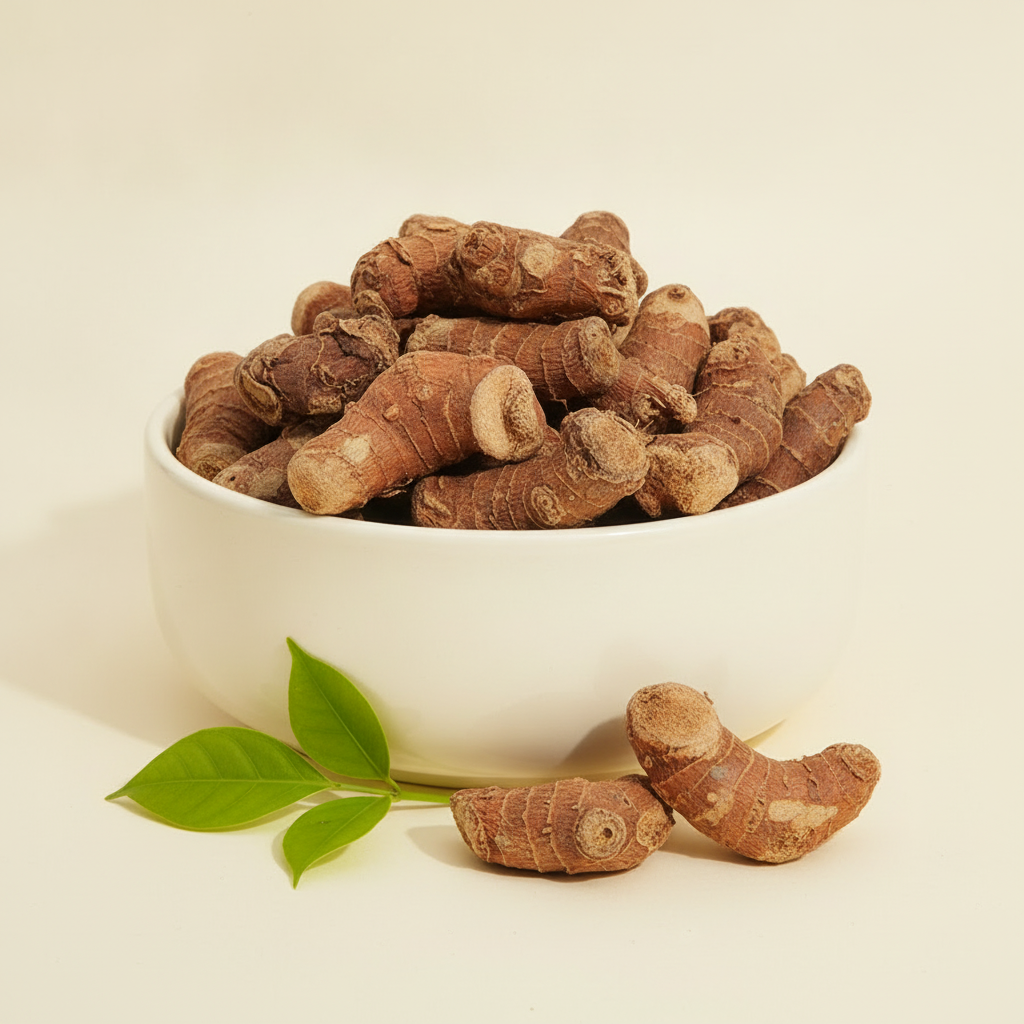
Paan ki Jad, Kulanjan, Kulinjan, greater galangal and Thai ginger are all names for the same herb: the dried rhizome of Alpinia galanga, a plant of the ginger family. Despite the trade name "betel root", it does not come from the paan (betel leaf) vine, Piper betle.
- Paan ki Jad, Kulanjan, Kulinjan and greater galangal are one herb: the dried rhizome of Alpinia galanga.
- Despite the trade name "betel root", it does not come from the paan (betel leaf) vine, Piper betle.
- Genuine Kulanjan is reddish-brown and knobby, with evenly spaced ring marks and a sharp, camphor-like smell.
- Galangal is a ginger-family cousin of adrak, but harder, redder and sharper in aroma.
- It is traditionally chewed for the throat and voice and boiled into winter kadhas.
One herb, many names
| Where | Name |
|---|---|
| Pansari trade (North India) | Paan ki Jad, Pan ki Jadd, Paan Jad, "betel root" |
| Hindi / Ayurveda | कुलंजन, कुलिंजन (Kulanjan, Kulinjan), Kulanjana |
| English | Greater galangal, galangal root, Siamese ginger, Thai ginger |
| Marathi | कोळिंजन (Kolinjan) |
| Tamil | பேரரத்தை (Perarathai) |
| Malayalam | അരത്ത (Aratta) |
| Thai | ข่า (Kha) |
| Botanical | Alpinia galanga (L.) Willd., family Zingiberaceae |
Why is it called "Paan ki Jad" if it isn't from the paan plant?
Pansari names are older than botany, and "Paan ki Jad" is simply the everyday name North Indian herb shops use for Kulanjan. The name suggests the paan plant, but the herb sold under it is galangal, a member of the ginger family. If you want the herb traditionally chewed for the throat and voice, this is the one people are asking for, whichever name they use.

Galangal vs ginger vs lesser galangal
| Kulanjan (greater galangal) | Ginger (adrak / saunth) | Lesser galangal | |
|---|---|---|---|
| Botanical | Alpinia galanga | Zingiber officinale | Alpinia officinarum |
| Look (dried) | Reddish-brown, knobby, clear ring marks, very hard | Pale tan, flatter "hands", softer | Thinner, darker red-brown |
| Inside | Cream to light orange, fibrous | Pale yellow | Reddish |
| Aroma | Sharp, camphor-like, citrusy-pine | Warm, sweet-spicy | Stronger, more pungent |
How to identify genuine Kulanjan
- Ring marks: evenly spaced rings around each knobby piece.
- Colour: reddish-brown outside, and pale cream to orange at the cut end.
- Hardness: very hard and woody. It doesn't snap as easily as dry ginger.
- Smell: scrape it with a knife. You should get a sharp, spicy, camphor-like smell.
Traditional uses
Kulanjan is traditionally chewed for throat and voice care, boiled into winter kadhas, and taken in small amounts as a warming digestive. Read the full guide in Hindi: पान की जड़ (कुलंजन) के फायदे. For methods, see how to use Paan ki Jad.
These are traditional uses, not medical claims. Avoid medicinal amounts during pregnancy and breastfeeding, and consult a practitioner if you have a health condition.
Shop Paan ki Jad (Kulanjan): raw or powder, 100g, ₹320 →
FAQ
Is Kulanjan the same as Paan ki Jad?
Yes. Paan ki Jad is the pansari trade name for Kulanjan, the rhizome of Alpinia galanga.
What is Kulanjan called in English?
Greater galangal, also sold as Siamese ginger or Thai ginger.
What is galangal called in Hindi?
कुलंजन (Kulanjan), also sold as पान की जड़ (Paan ki Jad).
Is galangal the same as ginger?
No. They are cousins in the same plant family, but galangal is harder, more reddish, and smells sharper and more camphor-like.
Sources
Written by the Dhanyawad Ayurved team and reviewed by Vaidya Ravinder Arora (40+ years), Dhanyawad Ayurved Vatika, Dwarka, New Delhi. This article describes traditional uses for general information. It is not medical advice. Consult a qualified doctor or Ayurvedic practitioner before using any herb therapeutically.

