

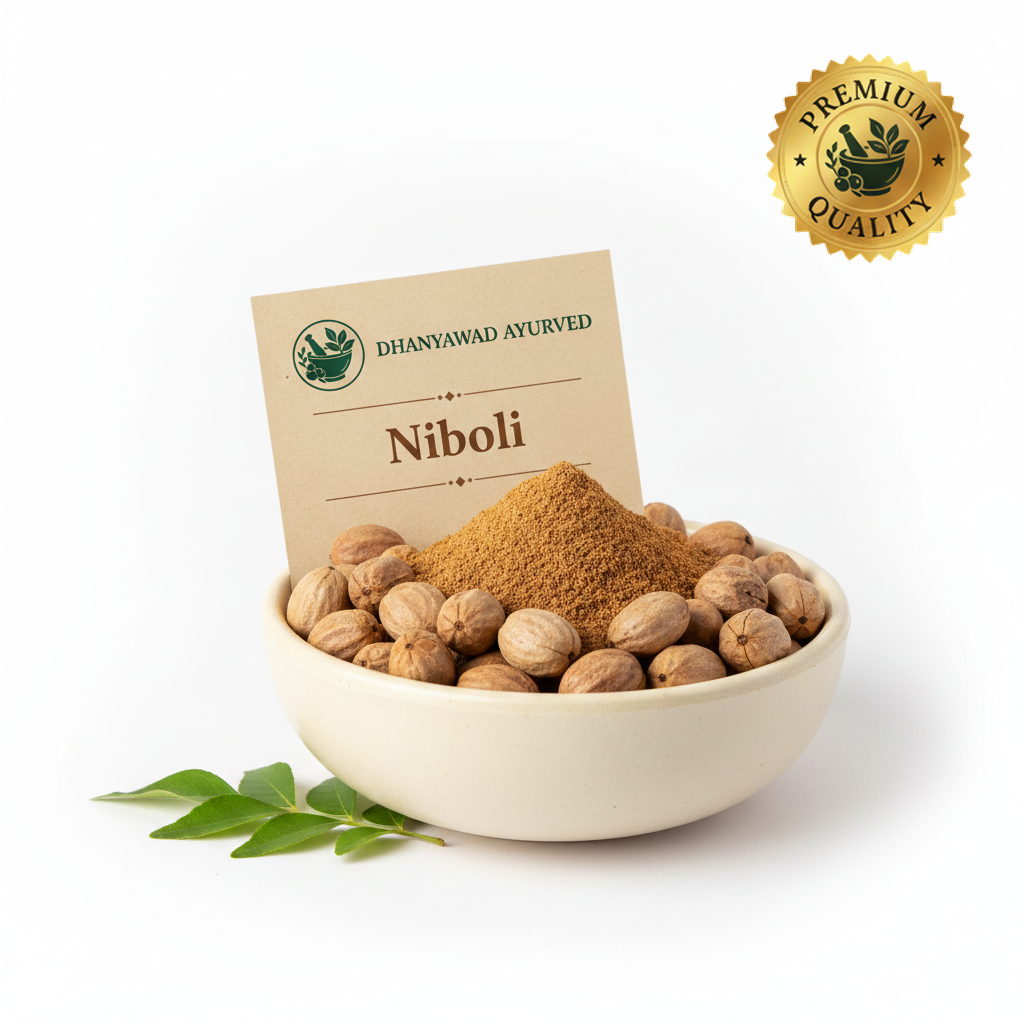
What is Niboli (Neem Fruit)?
Niboli is the ripened drupe (stone fruit) of Azadirachta indica, the neem tree native to the Indian subcontinent. Each fruit is small — about 1–2 cm long — oval, smooth and yellow-green when ripe, drying to a brownish-yellow. Inside is a hard seed (the neem kernel) surrounded by a thin bitter pulp. The entire fruit, including the kernel, is used in Ayurvedic and traditional practice. Neem (Nimba in Sanskrit) is one of the most extensively used herbs in classical Ayurveda, and niboli — the fruit — carries the same bitter, cooling and detoxifying properties as the leaf, but in a more concentrated form. In traditional practice, niboli is particularly valued for blood purification, skin conditions and as a bitter digestive tonic.
Names in other languages
| Language | Name |
|---|---|
| Hindi / Pansari | निबोली (Niboli), निंबोली (Nimboli), नीम फल (Neem Phal) |
| English | Neem Fruit, Neem Berry, Neem Kernel |
| Sanskrit / Ayurveda | निम्ब फल (Nimba Phala), अरिष्ट (Arishta) |
| Marathi | लिंबोळी (Limboli) |
| Tamil | வேப்பம்பழம் (Veppampazham) |
| Telugu | వేప పండ్లు (Vepa Pandlu) |
| Kannada | ಬೇವಿನ ಕಾಯಿ (Bevina Kayi) |
| Bengali | নিম ফল (Neem Phal) |
| Botanical | Azadirachta indica A. Juss. (Meliaceae), ripe fruit |
How to identify genuine Niboli
- Appearance: small oval to round fruits, 1–2 cm long; dried niboli is light brown to yellowish-brown, slightly wrinkled.
- Texture: dry, hard outer skin; inside, the kernel is enclosed in a thin fibrous shell.
- Taste: intensely bitter — among the most bitter of Ayurvedic herbs. Genuine niboli should be unmistakably and strongly bitter.
- Smell: characteristic neem smell — earthy, slightly oily and bitter. No fermented, mouldy or off smell.
- Powder form: pale beige to light brown fine powder with a strong bitter smell and taste.
- Watch out for: mould or damp smell (poor storage), very light colour without bitterness (diluted or old stock), or adulterants mixed in to bulk up weight.
Traditional uses of Niboli
In Ayurvedic and traditional pansari practice, niboli has traditionally been used as:
- Blood purifier: neem fruit is one of Ayurveda's primary raktashodhaka (blood-purifying) herbs, traditionally used for skin conditions associated with blood impurities — boils, rashes and chronic skin problems.
- Skin health support: applied externally in traditional preparations for acne, eczema and fungal skin conditions; internally as a bitter tonic to support clear skin from within.
- Bitter digestive tonic: the bitter compounds in niboli (nimbin, nimbidin) stimulate bile secretion and digestive enzyme activity — a traditional use for sluggish digestion and intestinal worms.
- Liver support: Ayurvedic texts mention neem fruit preparations for supporting liver function. If you have a liver condition, consult a doctor before use.
- Antimicrobial action: azadirachtin and other limonoids in niboli have been studied for antimicrobial properties. Traditionally used in preparations for bacterial and fungal skin conditions.
These are traditional uses based on Ayurvedic classical texts. Niboli is an herbal supplement; it is not a substitute for medical treatment. Consult a doctor for any skin disease, liver condition or other health concern.
How to use Niboli
- Powder with water or honey: ¼ teaspoon (approx. 1–2 g) of niboli powder with warm water or honey once daily. This is the standard traditional dose.
- With ghee: a small amount of niboli powder mixed with ghee — a classical preparation for skin conditions in Ayurvedic practice.
- Raw whole fruit: traditionally, 3–5 ripe niboli are eaten in the morning on an empty stomach during neem season — a very traditional practice for blood purification and skin health.
- Important: niboli is intensely bitter and powerful. Start with the smallest dose and increase gradually. Do not use large amounts continuously without guidance from a qualified Ayurvedic practitioner.
Raw vs powder — which to choose?
Raw whole niboli is the traditional form — the fruit is kept intact with all compounds preserved. Powder is more convenient for mixing into preparations and measuring accurately. Both forms are suitable; choose powder for ease of use and raw fruit if you prefer traditional whole-herb practice.
Product details
| Product | Niboli | Neem Fruit | Neem Kernel | निबोली |
| Botanical source | Azadirachta indica A. Juss. (Meliaceae) |
| Part used | Ripe dried fruit (including kernel) |
| Pack size | 100g |
| Form | Raw whole fruit or Powder |
| Price | ₹65 per 100g |
| Ingredients | 100% Niboli (neem fruit), no additives |
| Storage | Airtight container, cool and dry place, away from sunlight and moisture |
| Sold by | Dhanyawad Ayurved Vatika, Sector 13, Dwarka, New Delhi |
| Delivery | Ships within 24 hours, delivered across India in 3–5 days |
Safety
Niboli is an intensely bitter and potent herb — use with care. Do not use during pregnancy — neem compounds may affect the foetus; this is a firm contraindication. Not for children under 12 at medicinal doses. Liver conditions: while niboli is traditionally used to support liver health, people with existing liver disease should consult a doctor before use — large amounts of neem compounds can be hepatotoxic. Diabetes: neem may lower blood sugar; if you take medication for diabetes, consult your doctor and do not stop prescribed medicine. People trying to conceive should avoid medicinal doses of neem, as animal studies suggest neem may affect fertility. Niboli is very bitter — excessive doses may cause nausea, vomiting or stomach discomfort. Stop use and consult a doctor if you experience any adverse reaction. Keep out of reach of small children.
Frequently Asked Questions
What are the benefits of neem fruit (niboli)?
Niboli is traditionally valued in Ayurveda as a blood purifier and skin health tonic. Its bitter compounds — nimbin, nimbidin and azadirachtin — are associated with antimicrobial, anti-inflammatory and digestive-stimulating properties. Traditional uses include blood purification, support for skin conditions, liver health support and intestinal health. These are traditional uses; niboli is a dietary supplement, not a medical treatment.
What is the taste (taseer) of neem — hot or cold?
In Ayurvedic classification, neem (including niboli) is sheeta veerya — cooling in nature. It is one of the primary cooling and bitter herbs, classed as tikta rasa (bitter taste) and used to balance pitta and kapha. Its cooling nature is part of why it is traditionally used for heat-related skin conditions and for purifying the blood.
What is neem khali (neem cake) used for?
Neem khali is the residue left after pressing neem fruit (niboli) for oil — it is primarily used as an organic fertiliser and pesticide in agriculture. It is high in nitrogen and has natural pest-repellent properties. Neem khali is not consumed medicinally; it is an agricultural product distinct from niboli, neem oil or neem leaf powder.
How many neem leaves should I eat in a day?
The question applies to neem leaves rather than niboli fruit, but the traditional guidance is similar. Traditionally, 4–5 fresh neem leaves or ¼ teaspoon of dried neem leaf powder daily is the conservative starting point. More is not better with bitter herbs — excess can irritate the stomach. For niboli (fruit), start with ¼ teaspoon powder or 2–3 whole fruits daily. Always begin with the smallest dose and increase gradually.
When should I not eat neem?
Avoid neem (including niboli) during pregnancy — this is a firm contraindication. Avoid medicinal doses if you are trying to conceive. Do not give medicinal doses to children under 12. If you have a liver condition, kidney disease or are on diabetes medication or blood-thinning drugs, consult your doctor before using neem. People scheduled for surgery should stop neem 2 weeks before the procedure due to potential blood sugar effects.
Is niboli the same as neem leaf?
No. Niboli is the ripe fruit (and kernel) of the neem tree. Neem leaf (patta) is the dried leaf. Both come from the same tree (Azadirachta indica) and share many properties, but their compound profiles differ — niboli contains higher concentrations of azadirachtin and fatty oils, while the leaf is rich in nimbin and quercetin. In traditional practice they are used in overlapping but distinct ways. Dhanyawad Ayurved stocks both.
Information reviewed by Vaidya Ravinder Arora (40+ years), Dhanyawad Ayurved Vatika, Dwarka, New Delhi. Traditional uses only; not medical advice.

VEGAN

NATURAL INGREDIENTS

CRUELTY FREE

Ethically Sourced

No Artificial Flavors

Made with Love
You may also like


Disclaimer: The information provided is for educational purposes only and is not intended to replace medical advice. Always consult a qualified Ayurvedic practitioner before using any herbal product for therapeutic use, as individual responses may vary based on one’s health condition, dosha constitution, and imbalances.

- Choosing a selection results in a full page refresh.
- Opens in a new window.
