

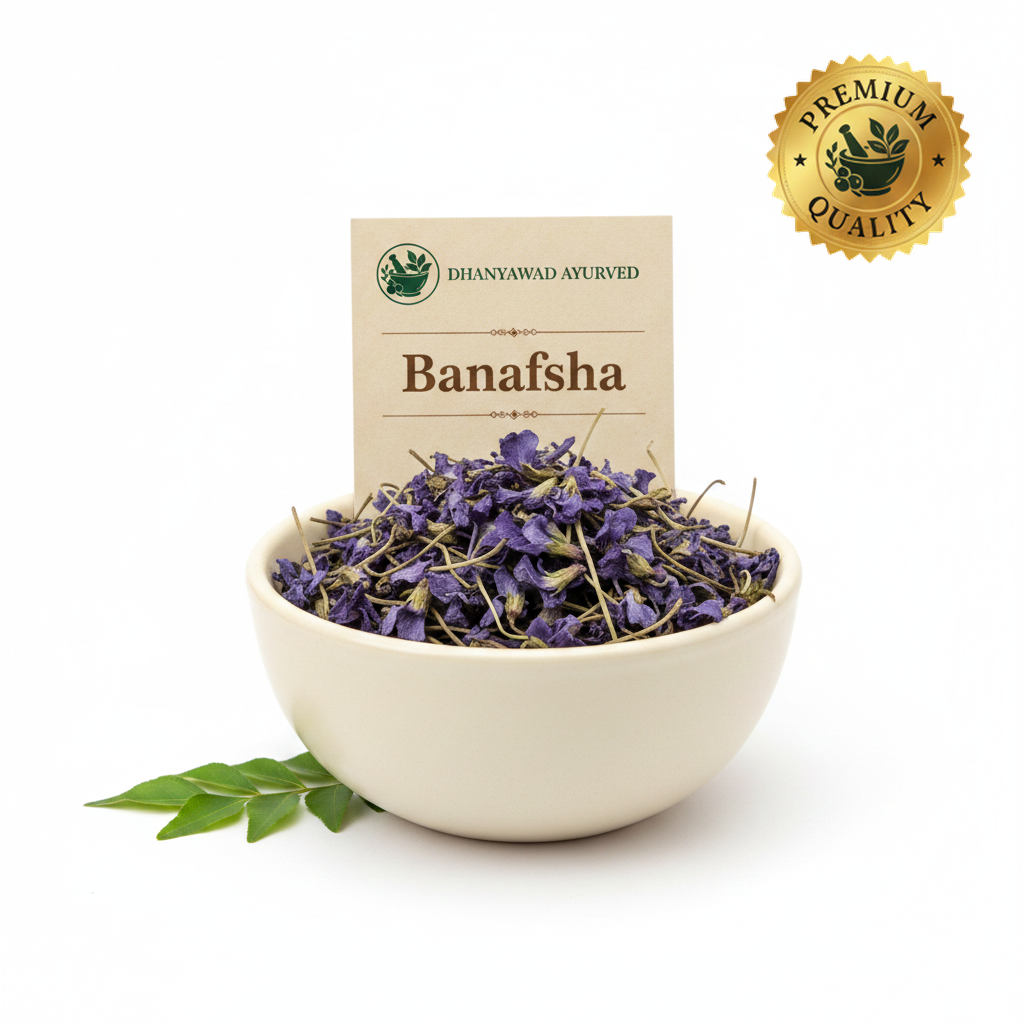
What Is Banafsha (Sweet Violet)?
Viola odorata is a low-growing perennial herb, 10–15cm tall, that spreads by stolons (runners). It has heart-shaped, dark green leaves and distinctive dark violet to purple flowers with a delicate, sweet fragrance — considered one of the most recognisable floral scents in perfumery. In Indian markets, Banafsha (also spelled Banafsa, Banapsha, or Gul-e-Banafsha) is sold as the dried flowers and upper herb — a premium botanical that is harvested in small quantities from Himalayan and temperate regions, which explains its comparatively higher price.
The plant's flowers contain flavonoids (violaxanthin, rutin), mucilage, salicylic acid derivatives, glycosides (viola saponin), and vitamin C. These constituents are linked to the herb's traditional respiratory-soothing and expectorant properties. In Unani medicine, Banafsha is categorised as Mukhaffif (demulcent) and Mulayin (laxative in larger doses), with its primary classical application being coughs, colds and throat irritation.
Names in Other Languages
| Language / System | Name |
|---|---|
| Hindi / Urdu | बनफशा (Banafsha), बनफ्शे (Banafashe), गुलबनफशा (Gul-e-Banafsha) |
| Sanskrit / Ayurveda | बनपुष्पिका (Banapushpika), नीलपुष्प (Nilapushpa) |
| English | Sweet Violet, Common Violet, English Violet |
| Persian / Farsi | بنفشه (Banafsheh — literally "violet") |
| Arabic | بنفسج (Banafsaj) |
| Bengali | বনফুলা (Banaphula) |
| Tamil | வண்ணக்கடம்பு (Vannakkadambu) |
| Botanical | Viola odorata L.; family Violaceae |
How to Identify Genuine Banafsha
Quality Banafsha sold in Indian pansari shops is the dried aerial herb — flower, stem and leaf. Here is what genuine Banafsha looks like:
- Colour: The dried flowers are deep violet to blue-purple — naturally occurring variation from purple to near-blue is normal. Pale, brown or yellow flowers indicate poor quality or old stock. A fully purple-violet colour is the sign of well-preserved, recently dried herb.
- Fragrance: A gentle, distinctive sweet-floral violet scent is characteristic. Fresh-dried Banafsha has a recognisable aroma even in dried form. Absence of fragrance indicates old stock; a musty or fermented smell indicates moisture damage.
- Texture: The dried flowers are small (1–1.5cm across), papery and fragile. The dried leaves are small, heart-shaped and slightly rough. The material should crumble slightly between your fingers without being dusty or mouldy.
- Adulteration: Other species of Viola or entirely different dried flowers are sometimes passed off as Banafsha. The unique sweet violet fragrance is the most reliable identifier — other Viola species often lack the distinctive scent of V. odorata.
Traditional Uses
Banafsha is one of the most valued respiratory herbs in the Unani tradition and is found in classical formulations like Khamira Banafsha. Traditionally, it has been used to support:
- Respiratory and cough support: The mucilage content of Banafsha coats and soothes the mucous membranes of the throat and upper respiratory tract. Traditionally, Banafsha tea (infusion) is used to ease dry, irritating coughs and catarrhal conditions of the respiratory tract. This is a traditional comfort use — it does not treat diagnosed respiratory infections.
- Throat irritation and hoarseness: A warm infusion of Banafsha with honey is a widely used traditional preparation for sore throat and throat dryness in Unani practice. The demulcent (mucilage-forming) action is well-supported by the plant's phytochemistry.
- Fever and cooling support: Classical Unani texts classify Banafsha as a cooling herb (Bard — cold in temperament) used in fevers to cool the body and promote sweating. It is traditionally used as a warm infusion for intermittent fevers.
- Expectorant properties: Banafsha is traditionally considered an expectorant — supporting the loosening and clearing of mucus from the respiratory tract. This aligns with its use in Khamira Banafsha and similar compound Unani preparations.
- Headache and sinus support (topical): In traditional Indian and Persian practice, fresh Banafsha flowers steeped in oil were applied to the temples for headache relief and to the forehead during sinusitis complaints.
- Mild laxative (larger doses): In larger amounts, Viola odorata has documented mild laxative effects. Classical Unani texts use it in controlled doses for constipation relief and bowel support. This application requires guidance on correct dose.
These are traditional uses in the Unani and Ayurvedic framework. Banafsha is a herbal support product — it does not treat, diagnose or cure any medical condition. If you have a persistent cough, fever lasting more than 3 days, or breathing difficulty, consult a doctor promptly. Do not delay medical treatment for diagnosed respiratory conditions.
How to Use Banafsha
- Banafsha tea (infusion — most popular method): Add 3–5g (approximately 1–1.5 teaspoons) of dried Banafsha to 250ml of just-boiled water. Cover and steep for 10–15 minutes. Strain and drink warm with a teaspoon of honey. Use up to 2 cups daily for cough and respiratory support.
- Combined with Mulethi and Ginger: A traditional Unani cold-and-cough tea combines equal parts Banafsha, Mulethi (licorice) and dried ginger (saunth), steeped together in hot water. This combination targets cough, throat irritation and congestion simultaneously.
- Khamira Banafsha (classical Unani formulation): This is a classical compound preparation containing Banafsha as a key ingredient — available from Unani medicine shops. Follow the directions on the preparation or your Unani practitioner's guidance.
- Banafsha decoction for fever: Boil 5g of Banafsha in 300ml water until it reduces to 150ml. Strain, cool slightly and drink as a warm infusion. Traditionally taken 1–2 times daily during fever for cooling and soothing support. Persistent fever (above 38.5°C for more than 3 days) requires immediate medical attention.
Product Details
| Attribute | Details |
|---|---|
| Botanical source | Viola odorata L. |
| Part used | Dried flowers and aerial herb |
| Pack sizes available | 20g, 100g |
| Form | Raw dried herb |
| Price | ₹190 / 20g · ₹850 / 100g |
| Storage | Store in a cool, dry, airtight container away from direct sunlight. Avoid moisture — dried flowers degrade quickly in humidity. |
| Sold by | Dhanyawad Ayurved Vatika, Sector 13, Dwarka, New Delhi |
Safety and Precautions
- Pregnancy: Violet (Viola odorata) in large medicinal amounts has not been conclusively studied in human pregnancy. Use only as a culinary herb in small amounts (culinary tea) during pregnancy; avoid medicinal doses.
- Large doses and laxative effect: High doses of Banafsha can cause loose stools or mild diarrhoea due to its saponin content. Stick to the recommended 3–5g per cup, 1–2 cups daily.
- Allergy to Violaceae family: Although rare, some individuals may be sensitive to plants in the Violaceae family. Discontinue use if you develop a rash, itching or any allergic reaction.
- Respiratory conditions: Banafsha may ease the discomfort of minor coughs and throat irritation, but it does not treat infections. If a cough persists beyond 10 days, is accompanied by fever, coloured sputum, or difficulty breathing, please consult a doctor immediately.
- Diabetes and blood pressure medication: No specific interactions are documented at normal use levels, but if you are on medication for chronic conditions, check with your doctor before adding any new herb regularly.
For a related blog on herbs for cough and respiratory support, see our guide Cough Home Remedies.
Frequently Asked Questions
What is another name for Banafsha?
Banafsha is known by several names: Gul-e-Banafsha (Urdu/Persian for "violet flower"), Banapsha, Banafsa, and in English, Sweet Violet or Common Violet. Its botanical name is Viola odorata. In Ayurveda it is referenced as Banapushpika or Nilapushpa (blue flower).
Which plant is called the queen of herbs in Ayurveda?
Tulsi (Ocimum tenuiflorum, Holy Basil) is most commonly called the "queen of herbs" in Ayurveda, prized for its broad immune and respiratory support. Banafsha is not given this title, but it is considered the leading classical herb in Unani medicine specifically for dry cough, throat irritation and respiratory comfort.
What are the benefits of drinking violet flower tea (Banafsha tea)?
Banafsha tea is traditionally used to soothe dry, irritating coughs, ease throat soreness, and support the body during colds and fevers. The mucilage in the flowers coats the throat lining, providing gentle relief. It is a traditional comfort preparation — it does not treat diagnosed infections or respiratory disease.
How to use Banafsha for cough?
Steep 3–5g of dried Banafsha in 250ml of hot water for 10–15 minutes. Strain and drink warm with honey, up to twice daily. For an enhanced effect, combine with Mulethi and dried ginger. For persistent or severe cough, consult a doctor — do not rely on herbal tea alone.
What are the benefits of using Banafsha syrup (Khamira Banafsha)?
Khamira Banafsha is a classical Unani compound preparation used for respiratory support, cough, throat irritation and catarrh. It is traditionally taken in 5–10g doses with warm milk or water. The preparation combines Banafsha with other Unani herbs for a combined soothing and expectorant effect. Follow the directions on the product label or use under Unani practitioner guidance.
What are the side effects of Khamira Banafsha?
Khamira Banafsha is generally well tolerated when used as directed. Side effects are uncommon at recommended doses. High doses or prolonged use may cause loose stools. It should not be used in high amounts during pregnancy. If any allergic reaction (rash, swelling, difficulty breathing) occurs, stop use and consult a doctor.
Is Banafsha good for fever?
In classical Unani medicine, Banafsha is categorised as a cooling herb and has traditionally been used in warm infusion form to support the body during fever — promoting mild diaphoresis (sweating) and reducing the discomfort of high temperature. This is a traditional support use. Fever above 38.5°C, lasting more than 3 days, or accompanied by other symptoms requires immediate medical attention.
What is the price of Banafsha per 100g?
Dhanyawad Ayurved Banafsha (Sweet Violet, Viola odorata) is priced at ₹850 per 100g and ₹190 per 20g. Banafsha is a premium Himalayan botanical harvested in limited quantities, which accounts for its price compared to more common herbs.
Information reviewed by Vaidya Ravinder Arora (40+ years), Dhanyawad Ayurved Vatika, Dwarka, New Delhi. Traditional uses only; not medical advice.

VEGAN

NATURAL INGREDIENTS

CRUELTY FREE

Ethically Sourced

No Artificial Flavors

Made with Love
You may also like


Disclaimer: The information provided is for educational purposes only and is not intended to replace medical advice. Always consult a qualified Ayurvedic practitioner before using any herbal product for therapeutic use, as individual responses may vary based on one’s health condition, dosha constitution, and imbalances.

- Choosing a selection results in a full page refresh.
- Opens in a new window.
