

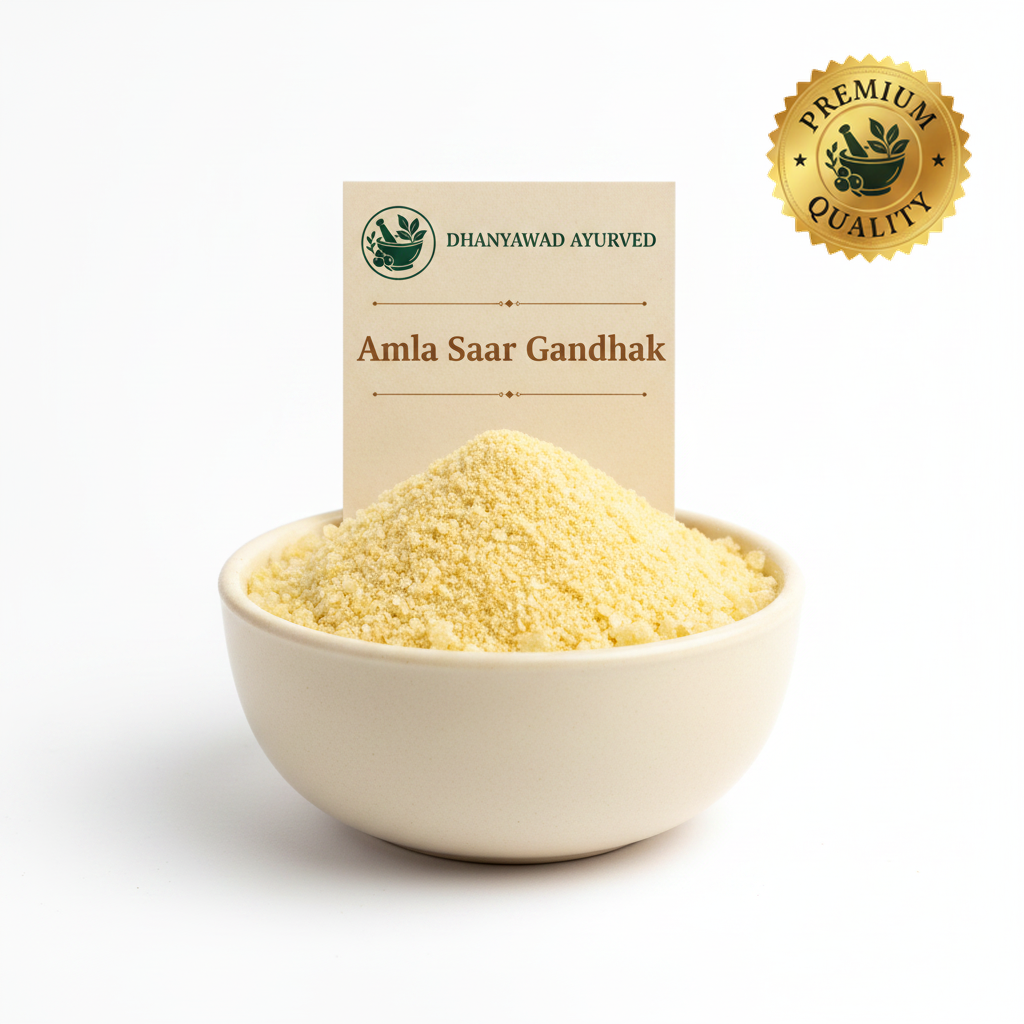
What is Amla Saar Gandhak?
The name breaks into two parts: Amla Saar means "essence of Amla (Indian gooseberry)" and Gandhak means sulphur. Amla Saar Gandhak is a processed mineral-herbal combination in which raw sulphur (yellow gandhak) has been processed using amla juice over repeated soaking-drying cycles — a classical Ayurvedic purification technique called shodhana.
This processing removes harsh impurities from raw sulphur, making it suitable for traditional use. The result is a light yellow powder with a faint sulphurous odour and the characteristic sour-astringent note of amla. It belongs to the Ayurvedic Rasashastra tradition and is different from Gandhak Rasayan (a patent medicine containing additional herbs). Read about the related herb in our blog post on Amla (Indian Gooseberry).
Names in other languages
| Language / Context | Name |
|---|---|
| Hindi / Pansari | आंवला सार गंधक (Amla Saar Gandhak), अमलसार गंधक (Amlasaar Gandhak) |
| Sanskrit / Rasashastra | गन्धक शोधित (Gandhak Shodhit), अमलसार |
| English | Amla Extract with Sulphur, Yellow Sulphur (Amla-processed), Purified Sulphur |
| Urdu / Unani | گندھک (Gandhak), کبریت (Kibreet) |
| Chemical identity | Elemental Sulphur (S, atomic number 16) processed with Amla |
| Related preparation | Gandhak Rasayan (contains additional herbs and processing) |
How to identify genuine Amla Saar Gandhak
- Colour: Pale to bright yellow powder or coarse granules. The amla processing may give it a slightly duller yellow than raw sulphur.
- Smell: A faint, characteristic sulphurous odour — but note that smell is not a reliable purity test. Raw industrial sulphur has a stronger smell; processed versions may smell milder.
- Solubility: Sulphur is insoluble in water but dissolves in hot oil. If the powder completely dissolves in plain water, it is adulterated.
- Texture: Should be a fine to moderately coarse dry powder, not clumped or sticky (clumping suggests moisture contamination).
- Source check: Buy only from a trusted pansari. Avoid unlabelled or extremely cheap material — raw industrial sulphur is not the same as Ayurvedic shodhit (purified) gandhak.
Amla Saar Gandhak vs raw Gandhak vs Gandhak Rasayan
| Raw Gandhak (Yellow Sulphur) | Amla Saar Gandhak | Gandhak Rasayan | |
|---|---|---|---|
| What it is | Unprocessed elemental sulphur | Sulphur processed with amla juice | Tablet/powder with sulphur + herbs + ghee/milk |
| Shodhana done? | No | Yes (amla-based) | Yes (classical process) |
| Safe to consume? | Not recommended internally | Traditional internal/external use | Classical formulation with vaidya's guidance |
| Sold as | Raw mineral | Pansari material | Branded Ayurvedic medicine |
Traditional uses of Amla Saar Gandhak
In the Ayurvedic Rasashastra tradition, processed gandhak is classified as having katu (pungent), tikta (bitter) and ushna (heating) properties. Its traditional uses include:
- Skin conditions: Traditionally used for chronic skin conditions including itching, scaling and mild infections. Applied externally as a thin paste or mixed with carrier oil to support skin health. These are traditional uses; no claim is made that it treats diagnosed skin diseases.
- Digestive support: In Rasashastra texts, shodhit gandhak is traditionally considered to support the digestive fire (agni) and may be used for chronic digestive sluggishness under vaidya guidance.
- Rejuvenation (Rasayana): Classical texts list gandhak among rejuvenating substances when properly processed — supporting general vitality and the body's immunity in traditional use.
- External applications: As a topical powder or mixed into oils for scalp and hair care; traditionally used for dandruff and mild scalp conditions.
All the above are traditional uses only. Amla Saar Gandhak is not a treatment for diagnosed conditions and should not replace medical care.
How to use Amla Saar Gandhak
Traditionally there are two modes of use — internal and external:
- Internal (only under guidance): 125–250 mg (a small pinch) once or twice daily with honey or ghee, as recommended by an Ayurvedic practitioner. Do not self-prescribe internal use of gandhak without professional guidance.
- External (topical on skin): Mix a small amount with coconut oil, sesame oil or neem oil and apply to the affected skin area. Leave for 20–30 minutes and wash off with mild soap. Test on a small area first.
- Scalp use: Mix ¼ teaspoon with 2 tablespoons of warm coconut oil; apply to scalp, leave 30 minutes, wash off. Can be used once or twice a week.
Product details
| Product | Amla Saar Gandhak | Amla Extract with Sulphur | आंवला सार गंधक |
| Nature | Mineral-herbal preparation (sulphur processed with amla) |
| Part used | Elemental sulphur, amla extract |
| Pack size | 100g |
| Form | Raw (powder/granules) |
| Price | ₹95 per 100g |
| Storage | Cool, dry place in an airtight container; keep away from heat, moisture and sunlight |
| Sold by | Dhanyawad Ayurved Vatika, Sector 13, Dwarka, New Delhi |
Safety
Amla Saar Gandhak should be used with care. Internal use is recommended only under the supervision of a qualified Ayurvedic practitioner or doctor — do not self-prescribe high doses. People with kidney disease, liver conditions, or those who are pregnant or breastfeeding should not use gandhak preparations internally without medical clearance. For external use, test on a small skin patch first; discontinue if redness or irritation develops. Keep away from children. Industrial sulphur is not the same as pansari or Ayurvedic shodhit gandhak and must never be consumed. If you experience any adverse reaction — skin rash, breathing difficulty, nausea or stomach pain — stop use and consult a doctor immediately.
Frequently Asked Questions
What is Amla Saar Gandhak used for?
Amla Saar Gandhak is traditionally used in Ayurvedic Rasashastra for supporting skin health, digestive fire and as a rejuvenating supplement. Externally it is used for chronic skin conditions and scalp care. Internally it is used under a vaidya's guidance for detoxification and immune support. It is a wellness material, not a treatment for diagnosed diseases.
What is the difference between Gandhak Rasayan and Amla Saar Gandhak?
Amla Saar Gandhak is raw shodhit (purified) sulphur processed with amla juice — a pansari material. Gandhak Rasayan is a complete classical Ayurvedic formulation (tablet or powder) that includes purified sulphur along with additional herbs, ghee and cow's milk, processed through many stages. Gandhak Rasayan is a ready-to-use medicine; Amla Saar Gandhak is the base mineral material used by practitioners in custom preparations.
Is Gandhak good for skin?
Sulphur has a long traditional and modern history of use for skin conditions — from classical Ayurvedic external pastes to modern topical acne creams that use sulphur as an active ingredient. In traditional use, amla-processed gandhak applied in oil is used for itching, scaling and mild scalp issues. These are traditional uses; if you have a diagnosed skin condition, please consult a dermatologist.
How to use Gandhak for external application on skin?
Mix a small amount (approximately ¼ teaspoon) with 2 tablespoons of carrier oil such as coconut, sesame or neem oil. Apply to the affected area, leave for 20–30 minutes, then rinse off thoroughly. Always do a patch test on a small area first. If skin irritation, redness or burning occurs, wash off immediately and do not repeat. Do not apply to broken or infected skin without a doctor's advice.
Can I take Amla Saar Gandhak daily?
Daily internal use should only be under an Ayurvedic practitioner's guidance. External use (scalp oil, skin application) 2–3 times per week is generally how it is traditionally used. Avoid continuous long-term internal use without professional monitoring. If you have kidney, liver or skin conditions, consult a doctor before any use.
What does "shodhana" mean for Gandhak?
Shodhana is the classical Ayurvedic purification process for minerals and metals. For gandhak (sulphur), shodhana involves soaking raw sulphur in amla juice over multiple cycles, which removes harsh volatile impurities and makes the sulphur more compatible with the body. Unshodhit (raw) sulphur is considered irritating and is not suitable for Ayurvedic use.
Is Amla Saar Gandhak the same as Gandhak Amlasar?
Yes — Amla Saar Gandhak, Amlasaar Gandhak, Gandhak Amlasar and Amlasar Gandhak are all different spellings of the same pansari material: sulphur that has undergone the amla-juice purification (shodhana) process. Regional spelling variations are common in pansari trade; the product is the same.
Information reviewed by Vaidya Ravinder Arora (40+ years), Dhanyawad Ayurved Vatika, Dwarka, New Delhi. Traditional uses only; not medical advice.

VEGAN

NATURAL INGREDIENTS

CRUELTY FREE

Ethically Sourced

No Artificial Flavors

Made with Love
You may also like


Disclaimer: The information provided is for educational purposes only and is not intended to replace medical advice. Always consult a qualified Ayurvedic practitioner before using any herbal product for therapeutic use, as individual responses may vary based on one’s health condition, dosha constitution, and imbalances.

- Choosing a selection results in a full page refresh.
- Opens in a new window.
