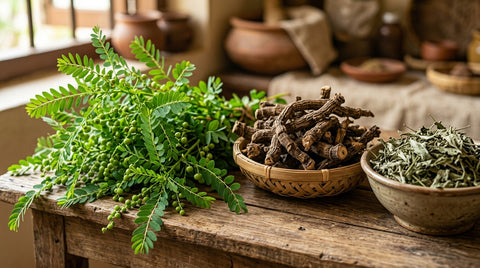
Punarnava Benefits: Kidney, Liver, Fluid Balance and How to Use Spreading Hogweed
What punarnava is, its key traditional benefits for kidneys, liver and fluid balance, how to use it as a powder or decoction, and who should consult a doctor first.
Punarnava (Boerhavia diffusa) is a creeping herb whose roots and leaves are used in Ayurveda as a diuretic and rejuvenating tonic. It is traditionally used to support kidney and liver function, reduce fluid retention, ease joint inflammation and aid digestion. It is not a treatment for diagnosed kidney or liver disease.
- Punarnava (Boerhavia diffusa) is traditionally classified as a diuretic and rasayana (rejuvenating) herb in Ayurveda; its name means "one that renews the body."
- Its strongest traditional use is for supporting kidney function, reducing water retention and clearing mild urinary complaints—not for treating diagnosed kidney disease.
- Punarnava supports liver health and fluid metabolism; people with liver disease, kidney disease, or on diuretic medication must consult a doctor before use.
- The standard adult dose is 3–5 g of powder twice daily with warm water, or 20–30 ml of kashayam (decoction); do not self-dose for more than 4–6 weeks without professional guidance.
- Pregnant women and people with low blood pressure or on antihypertensive medication should avoid punarnava without medical supervision.
What is Punarnava?
Punarnava is a perennial spreading weed native to India and found across tropical and sub-tropical regions worldwide. Its name in Sanskrit means puna (again) + nava (new) — "one who renews." Both the root and the above-ground parts are used in Ayurveda. The plant belongs to the Nyctaginaceae family and is botanically identified as Boerhavia diffusa.
In classical Ayurvedic texts including the Charaka Samhita, punarnava is listed among the important herbs for urinary disorders, fluid balance and liver conditions. The plant is also used in Unani medicine (as Bishkhapra). You can read the detailed Hindi guide at Punarnava ke Fayde.
Punarnava names in different languages
| Language / Context | Name |
|---|---|
| Hindi | पुनर्नवा (Punarnava), गदहपूर्णा |
| Sanskrit | पुनर्नवा (Punarnava), शोथघ्नी (Swelling-remover) |
| English | Spreading Hogweed, Horse Purslane, Pigweed |
| Tamil | முக்கரட்டை (Mukkuratai), சிறுகண்ணேலி |
| Telugu | గాళ్ళేరు (Galijeru) |
| Marathi | घेटुळी (Ghetuli), वसुदेव |
| Kannada | ಸಣ್ಣ ಗರ್ಜನ (Sanna garjana) |
| Botanical name | Boerhavia diffusa L. |
How to identify genuine Punarnava
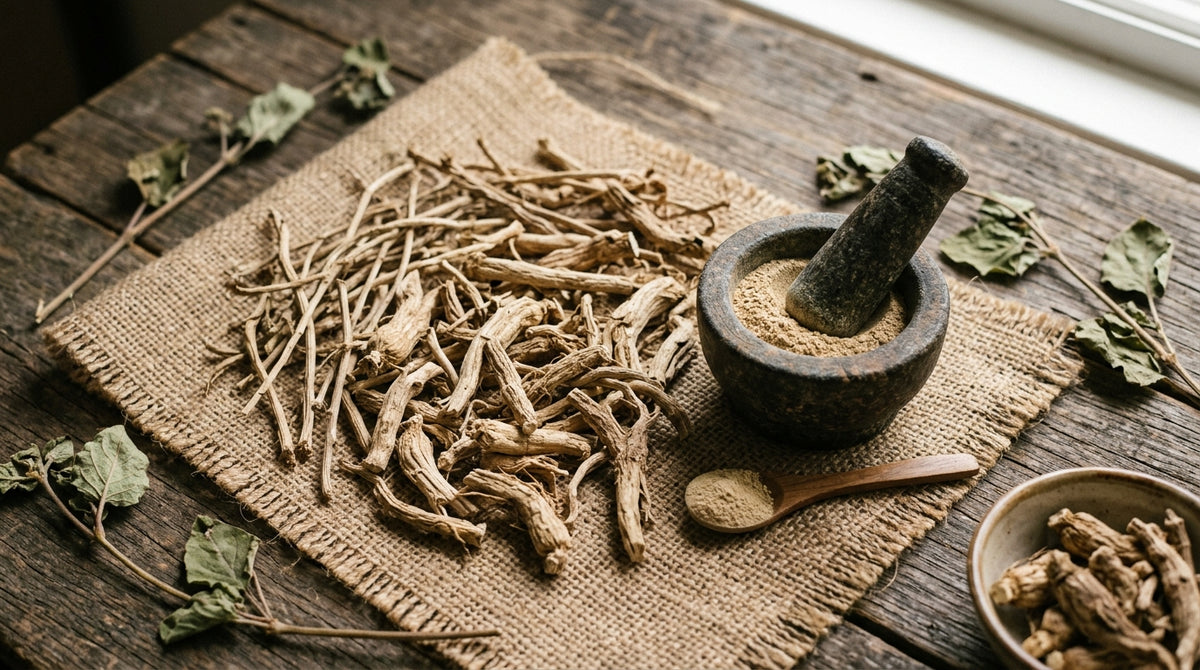
The key identifiers of quality Punarnava root (the part typically sold in pansaris):
- Root colour: Pale grey-brown to tan externally; white to pale yellow inside when freshly cut.
- Texture: The dried root is hard, cylindrical with a fibrous cross-section. Powdered punarnava should be a light tan colour.
- Taste: Slightly bitter and astringent with a mild sweet aftertaste — the hallmark of genuine punarnava root.
- Adulteration: Lower-grade material may contain other roots or dried stems only. Always buy from a trusted pansari with visible root pieces.
Is Punarnava good for the liver and kidneys?
This is the most commonly asked question about punarnava — and for good reason. Punarnava's primary Ayurvedic classification is as a mutravirajaniya (urinary-system supporting herb) and shothahara (swelling-reducer). Specifically:
Kidney support: Punarnava has a mild diuretic action, meaning it supports the kidneys in clearing excess water from the body. This makes it traditionally useful for puffiness, mild water retention in the legs and ankles, and supporting general urinary flow. It is used in classical Ayurvedic kidney formulations such as Punarnavadi Mandur and Punarnavarishta.
Liver support: Punarnava root has traditionally been used to support liver function and in the management of jaundice in Ayurvedic practice. It may support the liver's bile secretion and clearance processes. People with diagnosed liver conditions should not replace medical treatment with punarnava and must consult their doctor before use.
Important caution: If you have a diagnosed kidney disease (CKD, nephrotic syndrome) or are on prescription diuretics, using punarnava without medical supervision can disturb fluid balance and electrolyte levels. Do not stop your prescribed treatment; use punarnava only as a complementary support with your doctor's knowledge.

Punarnava for fluid retention and oedema
One of punarnava's most well-recognised traditional uses is reducing oedema — the swelling caused by fluid accumulation in tissues. In Ayurveda this is called shotha. The herb promotes urine output, helping to clear the excess fluid from the tissues. This is why classical formulations like Punarnavadi Kwatha are used for oedema associated with conditions like heart disease, kidney conditions or nutritional deficiency. Again, for diagnosed oedema, always work with a doctor — punarnava is a supportive herb, not a sole remedy.
Digestive and liver support
Beyond the kidneys, punarnava supports the digestive system as a mild appetising herb. It is used in Ayurveda for loss of appetite, sluggish digestion, and to ease the liver burden in cases of mild jaundice. The anti-inflammatory properties of punarnavine (an alkaloid in the root) are thought to reduce inflammation in the gut lining. For sluggish digestion, punarnava powder can be taken with ginger and warm water after meals. See also our guide to Mulethi for gut health.
Joint health and anti-inflammatory support
In Ayurvedic and traditional Indian folk medicine, punarnava is used for joint pain and mild arthritis because of its shothahara (inflammation-reducing) action. The herb supports the removal of fluid accumulation around joints, which can reduce stiffness. It is often combined with other herbs like giloy and sunthi (dry ginger) for joint care. For a chronic joint condition, punarnava should complement — not replace — your prescribed treatment. Read our post on Giloy benefits for a related immune and anti-inflammatory herb.
How to use Punarnava
Dhanyawad Ayurved Vatika's Punarnava root and powder are available in 100 g packs at ₹85. The herb can be used in several forms:
| Form | Dose (adult) | Method | Traditional purpose |
|---|---|---|---|
| Root powder (churna) | 3–5 g (½–1 tsp) | With warm water, twice daily after meals | Kidney/liver support, fluid balance |
| Kashayam (decoction) | 20–30 ml (boil 1 tsp root in 2 cups water, reduce to ½ cup) | Twice daily, morning and evening | Oedema, urinary support |
| Powder with honey | 3 g powder + 1 tsp honey | Morning, empty stomach | Liver support, rejuvenation |
| Combined formula | As per classical combination | Under vaidya guidance only | Complex conditions (kidney, heart) |
Start with the lower dose and increase gradually. Do not use continuously beyond 6 weeks without consulting a vaidya or Ayurvedic practitioner.
Who should avoid Punarnava?
Punarnava is generally safe at the above doses for healthy adults, but these groups must consult a doctor first:
- Pregnant women: Punarnava has uterine-stimulating properties in classical texts; it should not be used during pregnancy without medical supervision.
- People with diagnosed kidney disease: The herb affects electrolyte balance; supervised use only.
- People on diuretics: Combining punarnava with prescription diuretics can cause excessive fluid loss and electrolyte disturbance.
- People with low blood pressure (hypotension): Punarnava may lower blood pressure further; avoid if you are on antihypertensive medication without doctor's clearance.
- Diabetic patients: Punarnava may have a mild blood-glucose effect; do not stop your diabetes medication and monitor carefully.
See a doctor immediately if you experience sudden severe swelling, pain on urination, blood in urine, sharp abdominal pain, or signs of severe dehydration after taking punarnava.
Frequently Asked Questions
What is Punarnava mainly used as in Ayurveda?
Punarnava is primarily used as a diuretic and fluid-balancing herb, supporting the kidneys, liver and the body's natural clearance of excess fluid. It is also classified as a rasayana (rejuvenating herb) that supports longevity and overall vitality in classical Ayurvedic texts like the Charaka Samhita.
Is Punarnava good for liver and kidneys?
Yes, punarnava is traditionally used for both. For the kidneys, it supports urinary output and mild fluid clearance. For the liver, it is used to support bile secretion and in recovery from jaundice. However, people with diagnosed liver or kidney disease must use it only under a doctor's supervision — it should complement, not replace, medical treatment.
What is the Tamil name for Punarnava?
In Tamil, punarnava is called முக்கரட்டை (Mukkuratai) or சிறுகண்ணேலி (Sirukanneli). In Telugu it is known as Galijeru. These regional names all refer to the same plant — Boerhavia diffusa.
Does Punarnava have side effects?
At normal doses (3–5 g powder twice daily), punarnava is generally well tolerated. Possible side effects at higher doses include loose stools, nausea, excessive urination and low blood pressure. Long-term uninterrupted use without breaks is not recommended. People on diuretics, BP or kidney medications face the highest risk of interactions.
How do you drink Punarnavadi kashayam?
Punarnavadi kashayam is a classical Ayurvedic liquid preparation. A simple home decoction: boil 1 teaspoon of punarnava root powder in 2 cups of water until it reduces to about half a cup. Strain and drink 20–30 ml twice daily, 30 minutes before meals. Proprietary versions should be taken as per the label instructions, typically 15–20 ml diluted with an equal quantity of warm water.
Can Punarnava reduce water retention in legs?
Yes, this is one of its most recognised traditional uses. Punarnava's diuretic action helps the body clear excess fluid from the tissues, which can reduce mild ankle and leg swelling associated with prolonged sitting, heat or minor dietary imbalance. For medically-caused oedema (heart, kidney or liver conditions), consult a doctor before using punarnava.
Sources
Written by the Dhanyawad Ayurved team and reviewed by Vaidya Ravinder Arora (40+ years), Dhanyawad Ayurved Vatika, Dwarka, New Delhi. This article describes traditional uses for general information. It is not medical advice. Consult a qualified doctor or Ayurvedic practitioner before using any herb therapeutically.