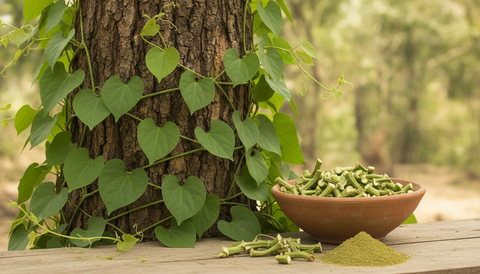
Giloy Benefits, Uses, Dosage and Side Effects – Complete Guide
Giloy (Guduchi, Tinospora cordifolia) benefits, how to use it, recommended dosage, important drug interactions, and who should not take it — an evidence-informed Ayurvedic guide.

Giloy (Guduchi; botanical name: Tinospora cordifolia) is one of Ayurveda's most revered herbs, called "Amrita" — meaning divine nectar — for its wide range of traditional uses. It is traditionally used to support immunity, aid recovery during fevers, support digestion, and act as a general rejuvenating tonic. It is available as raw stem, powder, juice, and tablets.
- Giloy is traditionally used in Ayurveda as an immunity tonic and is known as "Amrita" (divine nectar) for its broad supportive properties.
- It may support the body during fevers, respiratory infections and seasonal illness when used alongside proper medical care.
- Available as raw stem, powder, juice and tablets — daily dose is typically 1–3 g powder or 20–30 ml juice.
- Giloy can interact with diabetes medicines, blood-pressure drugs and immunosuppressants — always tell your doctor if you take it.
- People with autoimmune conditions, those on immunosuppressant therapy, and pregnant women should avoid Giloy without medical advice.
What Is Giloy?
Giloy is a large, deciduous climbing shrub native to India. It grows prolifically in tropical and subtropical forests and is easily found climbing over trees — especially neem trees, whose proximity is believed by some Ayurvedic practitioners to enhance Giloy's properties. The stem and root are the medicinally used parts. The stem is the most commonly sold form.
| Language | Name |
|---|---|
| Hindi | गिलोय / Giloy / Giloye |
| English | Heart-leaved Moonseed / Tinospora |
| Sanskrit | Guduchi / Amrita / Chakralakshni |
| Botanical name | Tinospora cordifolia |
| Tamil | Seenthil kodi |
| Marathi | Gulvel / Ambarvel |
| Bengali | Gulancha |
In Ayurvedic pharmacology (dravyaguna), Giloy is classified as tridoshic — it is said to balance all three doshas (Vata, Pitta, Kapha) and is considered a Rasayana (rejuvenative) herb, meaning it is used for long-term wellness rather than just acute conditions.
How to Identify Genuine Giloy
The raw stem (the most commonly sold form) can be verified by these features:
- The outer bark is greenish-grey with distinctive aerial roots hanging from the nodes.
- When you cut the stem cross-sectionally, the interior is white-cream with a radially patterned cross-section resembling a wagon wheel.
- The stem has a slightly bitter, starchy taste — it produces a mild starchy mucilage when chewed.
- The leaves are heart-shaped (cordate), hence "heart-leaved moonseed."
- Avoid dark-brown or hollow stems — these indicate old, degraded material.
Key Benefits of Giloy
1. Supports Immunity
Giloy is traditionally considered one of Ayurveda's primary immune tonics. The active alkaloids — including berberine, palmatine, and tinosporine — are thought to modulate immune activity. It is commonly used as a preventive daily tonic during seasons of high infection. Note: because it modulates immune activity, people with autoimmune conditions should consult a doctor before use.
2. Traditionally Used During Fevers
Giloy has been used in classical Ayurveda for "jwara" (fever) for centuries. It is used as a supportive herb alongside standard medical treatment during dengue, malaria and other febrile illnesses — it does not replace prescribed medicines. If you have a persistent fever, see a doctor.
3. Supports Digestion
Giloy is traditionally used to improve appetite, reduce acidity, ease constipation, and support overall gut health. It is believed to act as a mild digestive stimulant. Some practitioners use it for IBS-type symptoms, though serious digestive disease requires proper medical evaluation.
4. Liver Health Support
Classically, Giloy is used as a liver tonic and in conditions of elevated liver enzymes, including jaundice. However, there are also documented case reports of Giloy-associated liver injury (hepatotoxicity) — see the Safety section. People with existing liver disease should consult a hepatologist before use.
5. Skin Benefits
Giloy is used in Ayurvedic skin care for conditions including eczema, psoriasis and general skin inflammation, attributed to its blood-purifying and anti-inflammatory traditional properties. Internal use in combination with neem is common in classical formulations. For persistent skin conditions, see a dermatologist.
6. May Help Maintain Healthy Blood Sugar Levels
Animal and in-vitro studies suggest Giloy extracts may help maintain blood sugar, but human clinical evidence is limited. It should never replace prescribed diabetes medicines. If you take diabetes medication and want to add Giloy, inform your doctor — combination use can cause blood sugar to drop too low (see Drug Interactions).
7. Supports Joint and Bone Health
Giloy is traditionally used in Ayurvedic formulations for arthritis and joint inflammation. It is one of the ingredients in classical preparations like Guduchyadi Kashayam. For diagnosed arthritis, use as a complement to, not a replacement for, medical treatment.
8. Stress and Mental Clarity
As a Rasayana herb, Giloy is traditionally used to support mental clarity, reduce fatigue and improve resilience to stress. This is consistent with its classification as an adaptogenic herb in modern herbal medicine literature.
How to Use Giloy
| Form | Method | Typical Use |
|---|---|---|
| Raw stem | Cut 3–4 inch stem, crush and boil in 2 cups water until 1 cup remains; strain and drink | Fever support, daily tonic |
| Powder (churna) | ½–1 tsp powder in warm water or honey, twice daily | Immunity, digestion |
| Juice (swaras) | 20–30 ml freshly extracted juice, once or twice daily | Immunity, fever, skin |
| Tablets/Ghan Vati | As per product instructions, typically 1–2 tablets twice daily with water | Convenient daily supplement |
| Giloy Satwa | 125–250 mg in water or honey; classical preparation for high fevers | Febrile conditions (with medical care) |

Recommended Dosage
Dosage varies by form and condition:
- Powder: 1–3 g per day (about ¼–½ tsp) for adults.
- Juice: 20–30 ml once or twice daily.
- Tablets: Follow product label; typically 500 mg–1 g extract per day.
- Duration: Up to 8–12 weeks; consult a practitioner for longer use.
- Children: Do not give to children under 5 without medical advice.
Drug Interactions — Important
This is a section most competitor pages skip. Giloy has documented interactions with several medicines:
- Diabetes medicines (metformin, insulin, glipizide): Giloy may lower blood sugar; combined use can cause hypoglycaemia. Always tell your doctor.
- Blood-pressure medicines: Giloy may lower BP; avoid high doses if on antihypertensives.
- Immunosuppressants (cyclosporine, tacrolimus): Giloy stimulates the immune system, which can directly oppose the action of immunosuppressants used after organ transplants or for autoimmune disease. Do not combine without specialist advice.
- Thyroid medicines: Some evidence suggests Giloy may affect thyroid hormone levels — inform your endocrinologist.
- Sedatives and sleep aids: May enhance sedation.
- Chemotherapy: Consult your oncologist; immune-stimulating herbs may interfere with certain cancer treatments.
Where to Buy Giloy
Dhanyawad Ayurved stocks Giloy raw stem and powder — both available at ₹85 per 100 g. Available online and at Dhanyawad Ayurved Vatika, Dwarka, Delhi. Read the Hindi guide for use tips: गिलोय के फायदे. Also see: Mulethi benefits, Isabgol benefits.
Side Effects and Safety
Giloy is generally well-tolerated at normal doses, but be aware of:
- Liver injury: A multicenter Indian study (PMC9134809) documented 43 cases of Giloy-associated acute liver injury, with autoimmune features in many patients. People with underlying liver disease, autoimmune conditions, or those who consumed it daily for 6+ weeks appear at higher risk. Stop use and see a doctor immediately if you develop jaundice, dark urine or significant fatigue.
- Low blood sugar: Especially if you take diabetes medicines — monitor glucose levels.
- Autoimmune flare: Because Giloy stimulates immune activity, it may worsen autoimmune conditions (rheumatoid arthritis, lupus, multiple sclerosis).
- Constipation or digestive upset: Some people experience this, especially with high doses.
- Pregnancy and breastfeeding: Insufficient safety data — avoid without medical advice.
Frequently Asked Questions
What are the 10 benefits of Giloy?
Giloy is traditionally used for: (1) immunity support, (2) fever and infection recovery, (3) digestion, (4) liver health, (5) skin conditions, (6) joint and bone health, (7) blood sugar maintenance, (8) stress and mental clarity, (9) eye health (as a daily tonic), and (10) general rejuvenation as a Rasayana herb. Note: these are traditional uses; Giloy does not treat or cure any disease.
Can you take Giloy every day?
Yes, Giloy is traditionally used as a daily tonic in Ayurveda. Most practitioners recommend cycles of 8–12 weeks followed by a break. Daily long-term use should be discussed with a healthcare professional, especially given the rare reports of liver injury with prolonged use.
Is Giloy safe for kidneys?
There is limited direct evidence on Giloy's effect on kidneys. It is generally considered safe at normal doses in people with healthy kidneys. However, people with chronic kidney disease should consult a nephrologist before using herbal supplements — the kidneys process many herbal compounds and can be affected by high doses or prolonged use.
Is Giloy good for periods?
Giloy is not specifically used in classical Ayurveda for menstrual regulation. Some practitioners include it in general women's health formulations for immunity and energy. For irregular periods or hormonal issues, consult a gynaecologist — do not replace prescribed treatment with herbal supplements.
Who should avoid Giloy?
Pregnant and breastfeeding women; people with autoimmune conditions (rheumatoid arthritis, lupus, Crohn's); people on immunosuppressant therapy; people scheduled for surgery within 2 weeks; and anyone with existing liver disease. People on diabetes, blood pressure or thyroid medication should consult their doctor before starting Giloy.
Are there any side effects of Giloy?
Most people tolerate Giloy well at normal doses. Possible side effects include blood sugar drop (especially with diabetes medicines), digestive upset, and — in some cases, especially with prolonged use or underlying conditions — liver injury. Giloy is among the most commonly reported causes of herb-induced liver injury in India. Stop use immediately and see a doctor if you develop yellowing of skin or eyes, dark urine, persistent nausea, or extreme fatigue.
Sources
Written by the Dhanyawad Ayurved team and reviewed by Vaidya Ravinder Arora (40+ years), Dhanyawad Ayurved Vatika, Dwarka, New Delhi. This article describes traditional uses for general information. It is not medical advice. Consult a qualified doctor or Ayurvedic practitioner before using any herb therapeutically.