Ayurvedic Cough Syrup: Ingredients, Benefits and How to Use
What goes into an Ayurvedic cough syrup, how the key herbs work, correct dosage and when you need a doctor rather than a syrup.

An Ayurvedic cough syrup blends herbs like Vasa (Adhatoda vasica), Mulethi (licorice root), Tulsi (holy basil) and dry ginger that are traditionally used to soothe throat irritation, support mucus clearance and ease breathing discomfort. It is a herbal wellness product that supports respiratory health; it does not replace prescribed medicines for serious respiratory conditions.
- An Ayurvedic cough syrup combines herbs like Vasa, Mulethi, Tulsi and dry ginger that are traditionally used to soothe throat irritation and support normal respiratory function.
- Vasa (Adhatoda vasica) is the primary bronchial-support herb in most classical formulas and is the natural source of the alkaloid vasicine.
- Mulethi (licorice root) coats the throat lining and is traditionally valued for both dry tickling and productive coughs.
- The standard adult dose is 2 teaspoons (10 ml) three times daily after meals; children aged 5–12 use 1 teaspoon three times daily.
- See a doctor if the cough has lasted more than 3 weeks, comes with fever above 38.5°C, blood in sputum or breathlessness.
What Is an Ayurvedic Cough Syrup?
An Ayurvedic cough syrup is a liquid herbal formulation that draws on centuries-old classical texts — primarily the Charaka Samhita and Ashtanga Hridayam — where individual herbs and poly-herbal formulas were prescribed for kasa (cough) and shwasa (respiratory distress). Modern Ayurvedic cough syrups are standardised liquid versions of those formulas, combining water-soluble herb extracts in a sweet base (often honey or jaggery) that also soothes the throat.
Ayurveda classifies cough into five types based on the aggravated dosha. A well-formulated syrup typically targets at least two of these:
- Vataja kasa (Vata-type): dry, irritating, tickling cough with little or no mucus
- Pittaja kasa (Pitta-type): cough with burning sensation, yellowish sputum
- Kaphaja kasa (Kapha-type): productive cough, heavy white-to-clear mucus, worse in the morning
Understanding the type helps you use the syrup at the right time and identify when symptoms suggest something more than a simple seasonal cough.
Key Herbs in Dhanyawad Ayurved Cough Syrup
Dhanyawad Ayurved Cough Syrup (₹115 / 100 ml) combines four classical respiratory herbs. Here is what each one does:
| Herb | Sanskrit / Hindi | Botanical Name | Traditional Role in Cough |
|---|---|---|---|
| Vasa | वासा / अडूसा | Adhatoda vasica | Bronchial support; helps loosen and expel mucus; contains vasicine alkaloid |
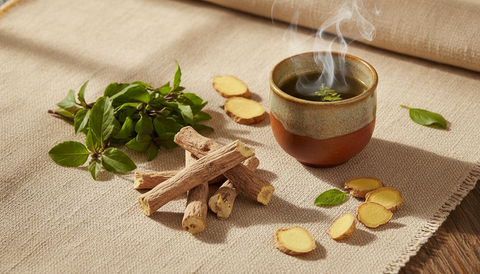
| Mulethi | मुलेठी | Glycyrrhiza glabra | Soothes throat and bronchial lining; expectorant and demulcent |
| Tulsi | तुलसी | Ocimum tenuiflorum | Supports immune response; warming, decongestant; traditional for febrile cough |
| Saunth (Dry Ginger) | सौंठ | Zingiber officinale | Warming, stimulates circulation, traditionally used for Kapha-type productive cough |
Vasa (Adhatoda vasica) — the core respiratory herb
Vasa, also known as Malabar nut or Adusa, is probably the single most studied Ayurvedic respiratory herb. Its alkaloid vasicine has been examined in laboratory settings for its potential to support bronchial musculature and thin mucus secretions. In classical Ayurvedic texts, Vasa is consistently listed as the primary herb for kasa (cough) and shwasa (breathing difficulty). Traditional preparations use the leaf juice or a concentrated extract of leaves and roots.
Mulethi (Glycyrrhiza glabra) — the throat coat
Mulethi is rich in glycyrrhizin, which gives it a naturally sweet taste and mucilaginous properties. In both Ayurvedic and Unani systems, it is used as an expectorant and demulcent — a herb that coats and protects irritated mucous membranes. It is one of few herbs used for both dry throat-tickle (Vata-type) and productive cough (Kapha-type). Read more in our detailed guide: मुलेठी के फायदे and Mulethi benefits in English.
Tulsi (Ocimum tenuiflorum) — the immune herb
Tulsi is revered in Ayurveda as a rasayana (rejuvenating) herb and one of the primary herbs for respiratory immunity. Its essential oils (eugenol, linalool) are traditionally used in steam inhalation and kadha (herbal decoction) for cough and cold. Tulsi supports normal immune response and is particularly used when cough accompanies a low-grade fever or general malaise.
Saunth (Dry Ginger) — the warming expectorant
Dry ginger is classified as katu (pungent) and ushna (hot) in Ayurveda. It is traditionally used to stimulate the digestive fire and simultaneously to warm and decongest the respiratory tract. Saunth is especially suited to Kapha-type productive cough — the heavy, white-mucus cough that is typically worse in the morning. See our full guide on सूखी खाँसी का इलाज.
How to Use Dhanyawad Ayurved Cough Syrup
| Age group | Dose | Frequency | When to take |
|---|---|---|---|
| Adults (18+) | 2 teaspoons (10 ml) | 3 times daily | After meals |
| Children (5–12 years) | 1 teaspoon (5 ml) | 3 times daily | After meals |
| Children under 5 | Consult a doctor | — | — |
Shake the bottle before each use. Do not exceed the stated dose. If symptoms have not improved after 5–7 days of use, consult a doctor. You can take this syrup alongside a doctor's prescribed medication unless your doctor advises otherwise — always inform your treating physician about all supplements you are using.
Which Ayurvedic Syrup Is Best for Cough?
There is no single "best" Ayurvedic cough syrup for everyone — the choice depends on the type of cough:
- Dry tickling cough (Vata-type): Choose a syrup with Mulethi and Honey as primary ingredients — they coat and soothe the airway.
- Productive cough with thick mucus (Kapha-type): A syrup with Vasa, Dry Ginger and Trikatu (three-pepper blend) helps loosen and expel mucus more effectively.
- Cough with fever and irritation (Pitta-type): Mulethi, Tulsi and Mishri (rock sugar) are the classical cooling formula.
Dhanyawad's formulation with Vasa, Mulethi, Tulsi and Saunth targets both Vata (dry-tickle) and Kapha (productive) cough patterns. For a detailed look at managing dry cough naturally, see cough home remedies.

Is Ayurvedic Cough Syrup Safe?
Ayurvedic cough syrups made from classical herb extracts are generally well-tolerated by healthy adults and older children when used at the recommended dose. The herbs in this formulation — Vasa, Mulethi, Tulsi and Ginger — have centuries of traditional use across India. As with any herbal product, a few precautions apply:
- Pregnancy: Consult your obstetrician before taking any herbal syrup during pregnancy. Dry ginger in medicinal doses may not be appropriate in the first trimester.
- High blood pressure: Licorice root (Mulethi) in high doses can affect blood pressure with prolonged use. At the standard 2-tsp three-times-daily dose for a short course, this is unlikely, but inform your doctor if you take antihypertensives. Do not stop any prescribed medication.
- Diabetes: Some Ayurvedic syrups contain sugar or honey. Check the label if blood glucose management is a concern.
- Children under 5: Do not self-administer herbal syrups to young children without paediatric advice.
This syrup supports respiratory comfort. It does not treat diagnosed lung conditions, asthma, COPD or bacterial infections.
How to Remove Mucus from Lungs in Ayurveda
Ayurveda uses several approaches to support mucus clearance from the respiratory tract — in addition to a cough syrup:
- Steam inhalation: Add a few drops of eucalyptus oil or 1 tsp of carom seeds (ajwain) to boiling water; inhale steam for 5–10 minutes. This thins mucus and eases clearance.
- Tulsi-ginger kadha: Boil 4–5 tulsi leaves, 1 tsp dry ginger and 1 tsp honey in 1.5 cups water. Drink warm twice daily.
- Nasya (nasal oiling): A drop of warm sesame oil in each nostril in the morning is a classical Vata-pacifying practice that keeps nasal passages moist and reduces post-nasal drip that triggers cough.
- Warm salt water gargle: Half teaspoon of rock salt in warm water; gargle for 60 seconds twice daily. Reduces throat inflammation.
These are complementary supportive measures — not substitutes for medical evaluation if symptoms are serious.
Where to Buy and Price
Dhanyawad Ayurved Cough Syrup is available at ₹115 for a 100 ml bottle. The syrup is prepared at Dhanyawad Ayurved Vatika, Sector 13, Dwarka, New Delhi, and ships across India within 24 hours. It contains Vasa, Mulethi, Tulsi and Saunth extracts in a traditional base. A 100 ml bottle provides approximately 10 days of treatment at the standard adult dose (2 tsp, 3×/day = 30 ml/day).
When to See a Doctor
This syrup is intended for mild, self-limiting cough — the kind that commonly accompanies seasonal changes, mild colds or throat irritation. See a doctor promptly if any of these red flags are present:
- Cough has lasted more than 3 weeks
- Fever above 38.5°C (101.3°F) lasting more than 3 days
- Blood in sputum or coughed-up material
- Breathlessness, chest pain or difficulty inhaling
- Unintended weight loss alongside chronic cough
- Night sweats combined with cough
- Worsening despite 5–7 days of home care
These symptoms may indicate bacterial pneumonia, tuberculosis, asthma or other conditions that require diagnosed treatment — not a herbal syrup.
Frequently Asked Questions
Which Ayurvedic syrup is best for cough?
The best Ayurvedic cough syrup for you depends on the type of cough. For dry, tickling cough: Mulethi-honey syrups work well. For productive cough with thick mucus: a Vasa + Ginger formulation is more effective. Dhanyawad's blend covers both, making it suitable for the most common seasonal coughs. Consult a vaidya or doctor for cough lasting over 3 weeks.
What is Ayurvedic treatment for cough?
Classical Ayurveda treats cough (kasa) by first identifying the dosha involved, then using herbs, diet changes and lifestyle modifications together. Herbs like Vasa, Mulethi, Sitopaladi churna and Talisadi churna are classical formulas. A liquid syrup combining these herbs is the most accessible form for home use.
What are the benefits of Khansi Ayurvedic cough syrup?
A well-formulated Ayurvedic cough syrup traditionally supports: throat soothing (Mulethi), bronchial comfort (Vasa), immune response during infection (Tulsi) and mucus clearance (Ginger). It is a support product for mild seasonal cough and works best when combined with warm fluids, steam and rest.
How do you remove a cough very fast?
No product removes a cough "very fast" — and any claim to do so should be treated with caution. Traditional approaches that provide the quickest symptomatic relief: warm honey-ginger water, steam inhalation with ajwain seeds, warm salt water gargle, and an Ayurvedic syrup taken regularly three times daily. Dry cough typically responds within 2–4 days of consistent care.
Can I take Ayurvedic cough syrup during pregnancy?
Consult your obstetrician or gynaecologist before taking any herbal supplement during pregnancy. Some herbs in cough syrups — including dry ginger in medicinal doses — are traditionally advised against in the first trimester. Warm honey-lemon water and steam inhalation are safer self-care options during pregnancy pending medical advice.
Does Ayurvedic cough syrup contain alcohol?
Most modern Ayurvedic cough syrups use a water-honey base or a simple syrup base, not an alcohol (asava/arishta) base. Dhanyawad's formulation is in a traditional liquid base without alcohol. If this is a concern, check the ingredients list on the bottle. Traditional arishta and asava formulations do contain self-generated alcohol but those are different products from liquid herb syrups.
Sources
Written by the Dhanyawad Ayurved team and reviewed by Vaidya Ravinder Arora (40+ years), Dhanyawad Ayurved Vatika, Dwarka, New Delhi. This article describes traditional uses for general information. It is not medical advice. Consult a qualified doctor or Ayurvedic practitioner before using any herb therapeutically.