

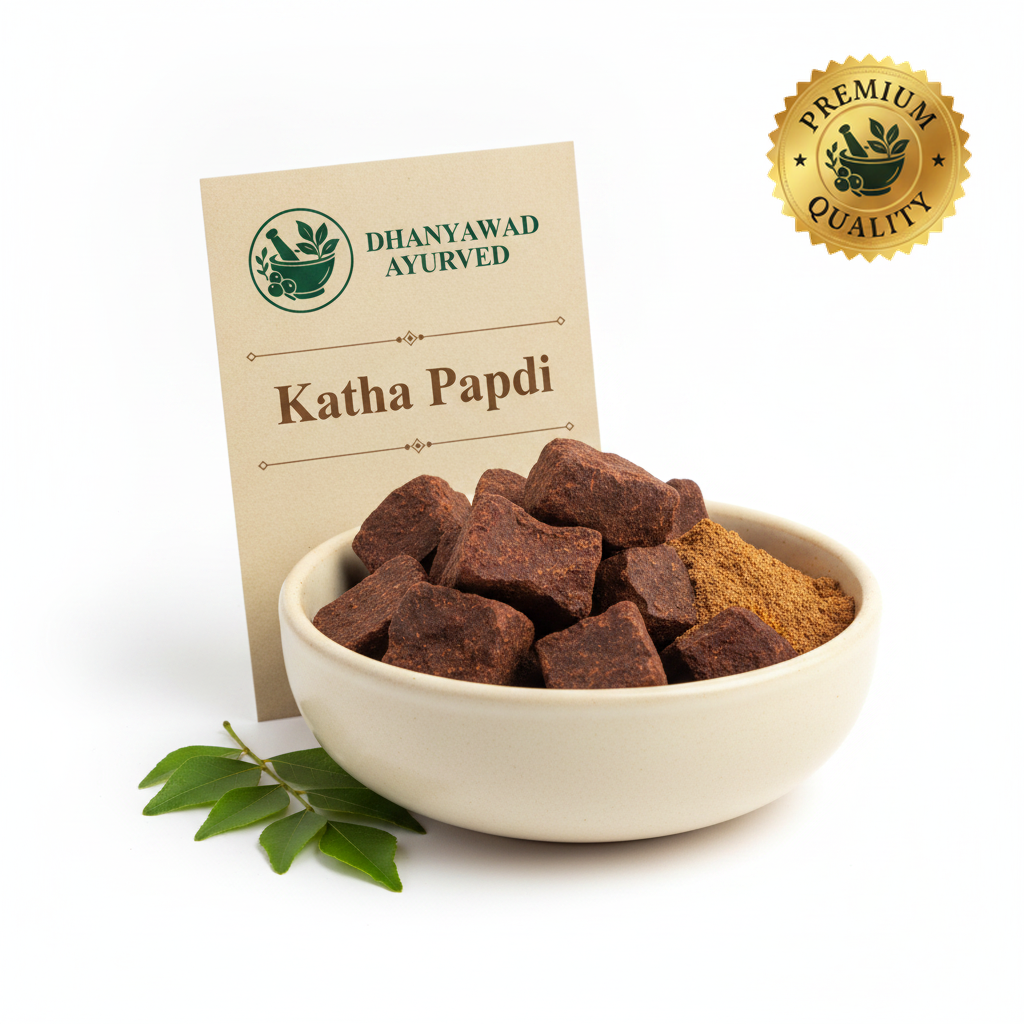
What Is Katha (Catechu)?
Katha (Catechu) is obtained by boiling the heartwood of Acacia catechu, a thorny tree native to India, Myanmar and parts of Southeast Asia, then drying the concentrated extract into hard, dark blocks or papdi (tablets/flakes). The dried extract is rich in catechins, epicatechins and condensed tannins — the compounds responsible for its astringent, bitter taste and its traditional uses in oral care and digestion. In Ayurveda, it is classified as Khadira and is used in classical formulations including Khadirarishta. It is also one of the key ingredients in the traditional paan preparation across India.
Names in Other Languages
| Language | Name |
|---|---|
| Hindi / Pansari | Katha / Kattha / कत्था / Katha Papdi |
| English | Catechu / Black Catechu / Cutch |
| Sanskrit / Ayurveda | Khadira / Kadara / Dantadhavan |
| Tamil | Kachu / Kaachu |
| Telugu | Kachchu / Tegadasi |
| Marathi | Khair / Katha |
| Bengali | Khayer / Kath |
| Botanical | Acacia catechu (L.f.) Willd. (Fabaceae), dried heartwood extract |
How to Identify Genuine Katha
Adulteration of Katha is common — starch, earth and inferior tree extracts are sometimes added. Here is how to identify genuine material:
- Colour: Genuine Katha Papdi is dark reddish-brown to chocolate-brown. Very pale or uniformly black pieces may indicate adulteration.
- Taste: Strongly astringent and mildly bitter — it will dry and pucker the inside of your mouth immediately on contact. Absence of astringency suggests low catechin content.
- Texture: Hard, brittle pieces that snap cleanly. Soft, waxy or crumbling Katha may be mixed with starch or fillers.
- Solubility: Genuine Katha partially dissolves in warm water, turning it light reddish-brown. It does not dissolve completely (the insoluble tannin fraction remains).
- Smell: Faint, slightly astringent earthy smell. No strong chemical, smoky or fermented smell.
Traditional Uses
In Ayurvedic and Indian household practice, Katha (Khadira) has traditional uses across several areas:
- Oral health: Katha is one of the most widely used traditional ingredients for oral hygiene across India. Its astringent and antimicrobial properties make it a classical ingredient in tooth powders, mouth rinses and gum-strengthening preparations. It is traditionally used to support gum health, soothe mouth ulcers and freshen breath.
- Paan ingredient: Katha is mixed with slaked lime (chuna) and betel leaf in traditional paan preparations across India. Its astringency balances the alkalinity of chuna and contributes to the characteristic red colouration of paan.
- Digestive support: In Ayurveda, Khadira is used as a digestive herb for conditions involving loose stools, dysentery and excessive secretions — its astringent action traditionally supports digestive toning. It is an ingredient in Khadirarishta, a classical Ayurvedic formulation.
- Skin support: Katha paste has traditional uses in Ayurvedic skin preparations for conditions including acne, eczema and minor wounds — its tannins are considered to have a drying, toning action on inflamed skin.
- Throat and respiratory support: traditionally used in small amounts for hoarseness, sore throat and cough — its astringent action soothes mucous membranes. Classical texts describe its use in throat formulations.
These are traditional uses. Katha is a traditional herbal material; it is not a medicine and does not treat or cure any disease. Consult a doctor for any diagnosed health condition.
How to Use Katha
- Mouth rinse: dissolve a small piece (about 1–2 g) in warm water; use as a rinse for sore gums or mouth ulcers. Do not swallow.
- Tooth powder: a pinch of Katha powder mixed with Triphala or rock salt makes a traditional tooth-cleaning powder.
- In paan: a small smear of Katha paste (mixed with a little water) on the betel leaf, alongside chuna, in traditional paan preparation.
- For sore throat: dissolve a small piece in warm water and gargle; a traditional home remedy for mild throat irritation.
- Culinary / internal use: very small amounts only — Katha is primarily used topically and as a paan ingredient, not as a standalone oral supplement. High internal doses are not recommended.
Product Details
| Product | Katha Papdi | Catechu | कत्था पापड़ी |
| Botanical source | Acacia catechu (L.f.) Willd. (Fabaceae) |
| Part used | Dried heartwood extract (papdi / blocks) |
| Pack size | 100g |
| Form | Raw (dried papdi / flakes) |
| Price | ₹320 per 100g |
| Storage | Airtight container, cool and dry place, away from moisture; shelf life 2+ years if kept sealed and dry |
| Sold by | Dhanyawad Ayurved Vatika, Sector 13, Dwarka, New Delhi |
| Delivery | Ships within 24 hours, delivered across India in 3–5 days |
Safety
Katha is safe in traditional food and oral-hygiene amounts. However:
- High internal doses: Katha is rich in tannins; high oral doses over a prolonged period may affect liver function. Use only in the traditional small amounts described above for internal use.
- Blood pressure medicines: Some evidence suggests catechu compounds may influence blood pressure — tell your doctor if you regularly consume large amounts alongside antihypertensive medicines.
- Immunosuppressants: Catechu may interact with immunosuppressant drugs (WebMD). Consult your specialist if you take these medicines.
- Pregnancy and breastfeeding: Avoid high doses; culinary/paan amounts are generally considered safe but consult your doctor if using as a supplement.
- Paan with tobacco: the risks associated with Katha in paan are significantly increased when paan is combined with tobacco or areca nut. Use without tobacco where possible.
See a doctor if you develop any unusual symptoms after using Katha, including mouth sores that do not heal, persistent digestive discomfort or any sign of allergic reaction. Keep out of reach of small children.
Frequently Asked Questions
Is catechu good or bad for you?
Katha (catechu) is safe in the small traditional amounts used for oral care and in paan. Its tannins and catechins have well-documented astringent and antimicrobial properties that support oral health and digestion in traditional use. The risks associated with Katha arise primarily from very high internal doses over a long period, or from its combination with areca nut and tobacco in paan — not from the Katha itself at traditional amounts.
Is kattha good for mouth ulcers?
Yes — Katha is one of India's most traditionally used remedies for mouth ulcers and sore gums. Its astringent tannins are thought to have a protective, drying action on inflamed oral mucosa. A common traditional approach is to dissolve a small piece in warm water and use as a rinse, or to apply a small amount of Katha directly to the ulcer. For persistent or recurrent mouth ulcers, consult a doctor as they may indicate an underlying condition.
Can we eat kattha?
Katha is consumed in small amounts as part of paan preparations and is present in some Ayurvedic formulations intended for internal use. However, it is not eaten in large quantities as a food — it is bitter and highly astringent and is used primarily for its oral health and digestive properties in small traditional amounts. Do not use large doses as a standalone supplement without guidance from an Ayurvedic practitioner.
What are the health benefits of Katha?
Katha (Khadira) is traditionally used for: oral health and gum support; mouth ulcer relief; sore throat and hoarseness; digestive support, especially for loose stools; skin health (topically for acne and minor wounds); and as a traditional ingredient in Ayurvedic formulations like Khadirarishta. These are traditional uses — catechu is not a treatment for any disease.
What are the side effects of Katha?
At traditional food/oral-care amounts, Katha is generally well tolerated. High internal doses may cause nausea, constipation and — with very prolonged high-dose use — potential liver stress due to tannin load. It may interact with blood pressure medicines and immunosuppressants. The greatest safety concerns with Katha arise from its use in paan mixed with areca nut and tobacco, rather than from Katha itself.
Is Katha good for hair?
In traditional Ayurvedic practice, Khadira (catechu) is used in some hair-care formulations, primarily as a scalp tonic due to its astringent properties — traditionally applied to support scalp health, reduce dandruff and strengthen hair roots. However, it is not one of the primary Ayurvedic herbs for hair; herbs like Bhringraj, Amla and Brahmi are more commonly used for this purpose. Consult a practitioner for a personalised hair-care regimen.
Information reviewed by Vaidya Ravinder Arora (40+ years), Dhanyawad Ayurved Vatika, Dwarka, New Delhi. Traditional uses only; not medical advice.

VEGAN

NATURAL INGREDIENTS

CRUELTY FREE

Ethically Sourced

No Artificial Flavors

Made with Love
You may also like


Disclaimer: The information provided is for educational purposes only and is not intended to replace medical advice. Always consult a qualified Ayurvedic practitioner before using any herbal product for therapeutic use, as individual responses may vary based on one’s health condition, dosha constitution, and imbalances.

- Choosing a selection results in a full page refresh.
- Opens in a new window.
