Cough Syrup Benefits – Ayurvedic Cough Syrup Uses, Dose and When to See a Doctor
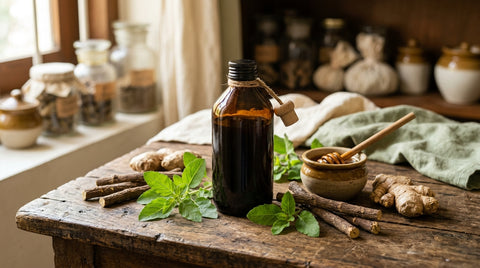
Dhanyawad Ayurved Cough Syrup blends Vasa, Mulethi, Tulsi, dry ginger and honey — herbs that support respiratory health in Ayurvedic tradition. Find out what each herb does, the right dose and when to see a doctor.
Dhanyawad Ayurved Cough Syrup (₹115 / 100 ml) is an Ayurvedic herbal liquid combining Vasa, Mulethi, Tulsi, dry ginger and honey — herbs that are traditionally used to soothe throat irritation, support mucus clearance and ease respiratory discomfort. It supports respiratory wellness in a traditional context; it does not replace prescribed medication for diagnosed respiratory conditions such as asthma, bronchitis or tuberculosis.
- Vasa (Adhatoda vasica) is the primary herb in Dhanyawad Ayurved Cough Syrup — classically used for bronchial support and helping loosen and clear mucus from the respiratory tract.
- Mulethi (Glycyrrhiza glabra) soothes throat irritation and is traditionally valued for both dry tickling coughs and productive coughs.
- The standard adult dose is 10 ml (2 teaspoons) three times daily after meals; children 5–12 years use 5 ml (1 teaspoon) three times daily.
- Ayurvedic cough syrup supports respiratory wellness — it does not treat bronchitis, asthma, TB, COVID-19 or any diagnosed respiratory disease.
- See a doctor if the cough has lasted more than 3 weeks, is accompanied by fever above 38.5°C, blood in sputum, chest pain or breathlessness.
What is in Dhanyawad Ayurved Cough Syrup?
Dhanyawad Ayurved Cough Syrup is formulated around four classical Ayurvedic respiratory herbs that appear repeatedly in Charaka Samhita and Ashtanga Hridayam for kasa (cough) and shwasa (respiratory distress). The syrup uses a honey base, which itself is classified as a throat soother and mucolytic (mucus-thinning) agent in classical Ayurveda.
| Herb | Hindi / Sanskrit | Botanical Name | Traditional Role |
|---|---|---|---|
| Vasa | वासा / अडूसा | Adhatoda vasica | Bronchial support; loosens and helps expel mucus; contains vasicine alkaloid |
| Mulethi | मुलेठी / यष्टिमधु | Glycyrrhiza glabra | Throat coating; anti-irritant; valued for both dry and wet coughs |
| Tulsi | तुलसी / सुरसा | Ocimum tenuiflorum | Immune support; traditionally used in seasonal cold, cough and mild fever |
| Dry Ginger | सोंठ / शुण्ठी | Zingiber officinale (dried) | Warming; kapha-reducing; aids expectoration; reduces throat inflammation |
| Pippali | पिप्पली | Piper longum | Deepens the action of other herbs; enhances bioavailability; anti-kapha |
| Honey | शहद / मधु | — | Throat soothing; natural mucolytic; vehicle for other herbs in Ayurveda |
Cough Syrup Benefits — What Each Herb Does
Vasa (Adhatoda vasica) — The Primary Respiratory Herb
Vasa, also called Malabar nut or Adhatoda, is the cornerstone herb in Ayurvedic respiratory formulas. In classical Ayurveda, it is classified as shwasahara (relieves respiratory distress) and kasahara (reduces cough). The alkaloid vasicine, found in Vasa leaves, has attracted scientific interest for its bronchospasmolytic properties, though the clinical evidence is early-stage. Traditionally, Vasa is used for both dry and productive coughs, and is particularly associated with kapha-type conditions — heavy mucus, morning worsening and congestion. It is not a substitute for bronchodilators, corticosteroids or antibiotics in diagnosed conditions.
Mulethi (Licorice Root) — The Throat Soother
Mulethi (Glycyrrhiza glabra) is one of the most widely used herbs in both Ayurvedic and Unani medicine for respiratory health. Its main traditional action is kanthya — soothing and strengthening the throat and voice. It is classified as shita virya (cooling) which makes it particularly useful for the burning sensation of dry, tickling coughs and pitta-type respiratory irritation. Mulethi coats the throat lining, reduces scratchiness and helps loosen thick mucus for easier expectoration. People with high blood pressure should use mulethi with caution — consult your doctor.
Tulsi — Immune Support and Seasonal Respiratory Health
Tulsi (Ocimum tenuiflorum), or holy basil, is revered in Ayurveda as an adaptogen and immune tonic. For coughs and colds, tulsi is specifically valued for its expectorant and anti-kapha properties — it helps the body clear mucus from the upper respiratory tract. In seasonal and weather-related coughs, tulsi is traditionally combined with ginger and honey in kadha (herbal decoctions). The essential oils in tulsi (eugenol, caryophyllene) contribute to its respiratory benefits in traditional practice.
Dry Ginger (Saunth) — The Warming Expectorant
Dry ginger (saunth) is the dried form of Zingiber officinale and is classified differently from fresh ginger in Ayurveda — it is more heating (ushna) and has a stronger anti-kapha action. Dry ginger works synergistically with other herbs in the formula: it stimulates circulation, reduces congestion and enhances the bioavailability of other active compounds. For cold-type coughs (clear or white mucus, worse in cold weather), dry ginger is traditionally the most valuable herb.
Pippali (Long Pepper) — The Synergist
Pippali (Piper longum) is known in Ayurveda as a yogavahi — a substance that enhances the action of other herbs. In respiratory formulas, pippali deepens the effect of Vasa and dry ginger. It is classically described as one of the three herbs of Trikatu (along with black pepper and dry ginger) and has a strong anti-kapha, expectorant action. Pippali is used in small amounts — excessive doses can be irritating.
Dry Cough vs Wet Cough — Which Type Does Ayurvedic Syrup Help?
| Feature | Dry Cough (Vata-type kasa) | Wet / Productive Cough (Kapha-type kasa) |
|---|---|---|
| Mucus | Little or none; tickling sensation | Abundant; white, grey or clear mucus |
| Timing | Often worse at night; persistent | Often worse in morning; eases after clearing mucus |
| Sensation | Dry, scratchy, throat irritation | Heaviness in chest; mucus rattling |
| Main herb for it | Mulethi (soothing), Tulsi | Vasa (expectorant), Dry ginger, Pippali |
| When syrup helps | Soothes throat, reduces irritation | Loosens mucus, aids expectoration |
| When to see a doctor | If lasting more than 3 weeks | If mucus turns yellow/green or bloody |
Dhanyawad Ayurved Cough Syrup contains herbs suited to both types of cough. For pittas-type cough (burning, yellow-green sputum, fever), the mulethi and honey provide cooling soothing. For the common seasonal kapha-type, Vasa and dry ginger are the primary actives.

Cough Syrup Dose and How to Use It
| Age group | Dose | Frequency | How to take |
|---|---|---|---|
| Adults (18+) | 10 ml (2 tsp) | 3 times daily, after meals | Directly or in a little warm water |
| Children 5–12 years | 5 ml (1 tsp) | 3 times daily, after meals | Directly or in a little warm water |
| Children under 5 | Not recommended without doctor | — | Consult a doctor first |
| Elderly (60+) | 5–10 ml | 2–3 times daily, after meals | Start with lower dose |
Why not drink water immediately after? In Ayurveda, cough syrups made with honey are traditionally recommended to be held in the mouth briefly and swallowed slowly so the herbs can coat the throat lining. Drinking water immediately dilutes the herbs before they can act. Wait 10–15 minutes before drinking water for best traditional results.
Buy Dhanyawad Ayurved Cough Syrup
Dhanyawad Ayurved, Dwarka, New Delhi stocks Cough Syrup (Vasa, Mulethi, Tulsi, Ginger, Pippali, Honey) — ₹115 / 100 ml. Free from synthetic preservatives and artificial colour. Suitable for seasonal and mild-to-moderate cough and throat irritation. Related reading: कफ सिरप के फायदे हिंदी में · Cough Home Remedies · Mulethi (Licorice Root) Benefits
Ayurvedic Cough Syrup vs Conventional Cough Medicine
Conventional over-the-counter cough syrups typically contain one of three classes of drugs: antitussives (cough suppressants like dextromethorphan), expectorants (guaifenesin, which thins mucus) or antihistamines (for allergy-driven coughs). Ayurvedic syrups like Dhanyawad's formulation work differently — they combine multiple herbs that have synergistic traditional actions rather than a single active drug. Neither type treats the underlying cause of serious respiratory illness; both manage symptoms. The main practical difference is that conventional syrups have more robust clinical evidence for specific symptoms, while Ayurvedic syrups are gentler, have a long traditional track record and have fewer known drug interactions for otherwise healthy adults.
Safety, Side Effects and Precautions
- High blood pressure: Mulethi (licorice) can raise blood pressure in large amounts or with long-term use. If you are on antihypertensive medication, consult your doctor before regular use.
- Diabetes: Honey in the syrup adds a small amount of natural sugar. People with diabetes should track the dose and check blood sugar if using the syrup long-term.
- Pregnancy: Pippali and dry ginger in large doses are generally avoided in pregnancy. For a cough during pregnancy, consult your doctor before using this or any cough syrup.
- Children under 2 years: Honey-containing products should not be given to infants under 2 years due to the risk of infant botulism. This syrup is not recommended for children under 5 without medical advice.
- Drug interactions: Mulethi may interact with certain corticosteroids and diuretics. If you are on regular medication, check with your doctor.
- Not for serious respiratory conditions: This syrup is not a treatment for asthma, COPD, pneumonia, tuberculosis, bronchiectasis or COVID-19. Use prescribed medication for diagnosed conditions.
See a doctor if: The cough has lasted more than 3 weeks; you have a fever above 38.5°C (101.3°F); there is blood in the sputum; you have chest pain, breathlessness or wheezing; a child under 2 is coughing; or you have a history of asthma, COPD or heart disease. These symptoms require medical assessment.
Frequently Asked Questions
What medicine can I take for a cough?
For a mild seasonal cough, an Ayurvedic herbal syrup (Vasa, Mulethi, honey base) is a traditional first step; over-the-counter expectorants or throat lozenges are other options. For a cough lasting more than 3 weeks, with fever above 38.5°C, chest pain, blood in sputum or breathlessness, see a doctor — a proper diagnosis is needed before choosing any medication.
Should we use cough syrup for every cough?
No — not every cough needs syrup. A mild, short-lived cough after a cold or due to throat dryness typically resolves on its own with rest, fluids and steam inhalation. Ayurvedic cough syrup is most useful for persistent seasonal coughs with throat irritation or mild mucus congestion. If the cough is severe, associated with fever, chest pain or breathlessness, see a doctor rather than relying on syrup.
What are the top cough syrups in India?
India has both conventional (Benadryl, Grilinctus, Corex-DX) and Ayurvedic (Vasaka, Zandu Kofol, Dabur Honitus) cough syrups widely available. Conventional syrups contain standard pharmaceutical active ingredients; Ayurvedic syrups use herbal extracts. The best choice depends on the type of cough and whether you have any contraindications. Dhanyawad Ayurved Cough Syrup (₹115 / 100 ml) is a pansari-grade Ayurvedic option using whole-herb extracts.
How do cough suppressants work?
Conventional cough suppressants (antitussives like dextromethorphan) work by suppressing the cough reflex in the brain. Ayurvedic cough syrup does not suppress the cough reflex — instead, it soothes the irritation that triggers the reflex (Mulethi, honey) and helps clear the mucus that causes productive coughing (Vasa, dry ginger, Pippali). This means the Ayurvedic approach addresses the cause of the cough rather than blocking the cough signal.
Why don't we drink water after cough syrup?
The recommendation to avoid drinking water for 10–15 minutes after cough syrup is specific to honey-based and herbal syrups. The idea is that the herbal compounds and honey coat the throat lining and need time to act on the irritated tissues. Drinking water immediately washes away this coating before it can soothe the throat. For conventional pharmaceutical syrups, this restriction generally does not apply — check the label instructions.
Is it better to cough or take cough syrup?
Coughing is a natural protective reflex — it clears the airway of mucus, irritants and pathogens. Suppressing a productive cough that is clearing mucus is generally not advised. For dry, non-productive coughs that are disrupting sleep or causing throat damage, syrup (which soothes the irritation rather than suppressing the reflex) is appropriate. Ayurvedic syrups like this one soothe rather than suppress, so they can be used even for productive coughs.
Can children use Dhanyawad Ayurved Cough Syrup?
Children aged 5–12 may use the syrup at half the adult dose (5 ml, three times daily). For children under 5, and especially under 2, consult a doctor before using any cough syrup containing honey. Honey-based products are not safe for infants under 2 years due to the risk of infant botulism.
How long does it take for Ayurvedic cough syrup to work?
Ayurvedic cough syrup typically provides throat-soothing relief within 15–30 minutes of taking a dose for mild symptoms. Sustained improvement in a persistent or seasonal cough usually takes 3–7 days of consistent use. If the cough does not improve after 7–10 days of regular use, see a doctor to rule out an underlying cause that requires specific treatment.
Sources
Written by the Dhanyawad Ayurved team and reviewed by Vaidya Ravinder Arora (40+ years), Dhanyawad Ayurved Vatika, Dwarka, New Delhi. This article describes traditional uses for general information. It is not medical advice. Consult a qualified doctor or Ayurvedic practitioner before using any herb therapeutically.