Ayurvedic Hair Oil: Bhringraj, Amla, Brahmi and How to Oil Your Hair Right
A complete guide to ayurvedic hair oil — the key herbs, how to identify a genuine product, the correct way to apply it, and which formulation traditionally supports hair fall and scalp health.
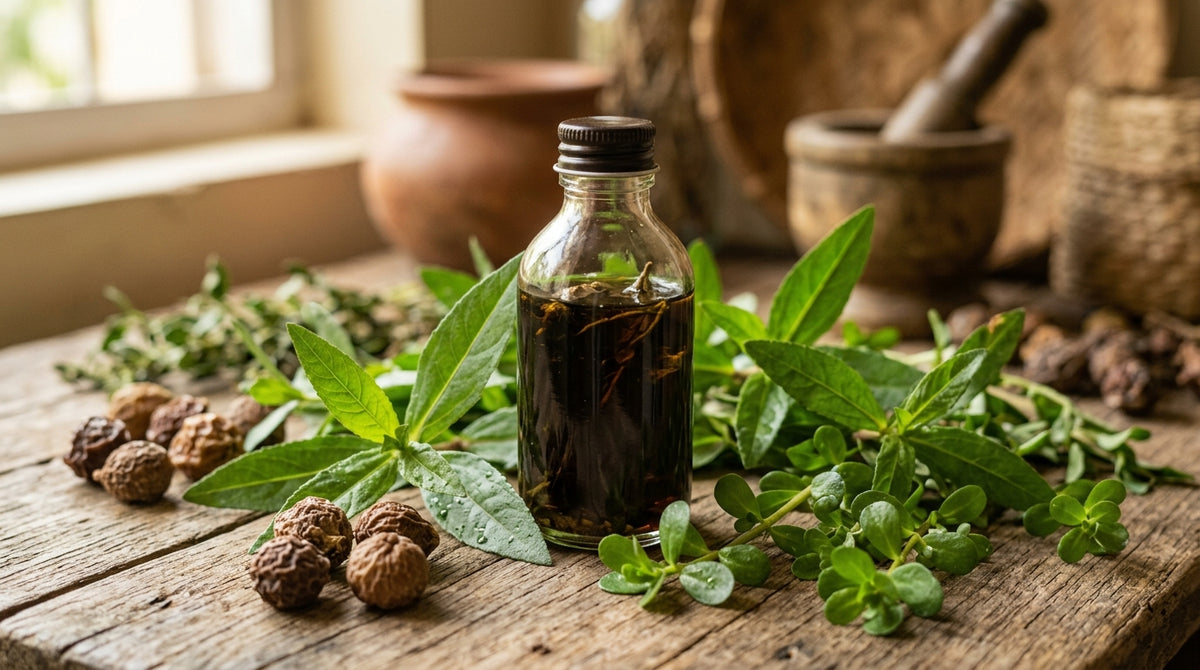
Ayurvedic hair oil is a herb-infused oil traditionally used to nourish the scalp, support healthy hair growth and reduce hair fall. The most important herbs are bhringraj, amla, brahmi and neem. Applied warm with a gentle scalp massage two to three times a week, a well-formulated ayurvedic oil supports long-term scalp health as part of a consistent routine.
- Bhringraj (Eclipta prostrata) is traditionally called the "king of hair herbs" and is the most widely used herb in ayurvedic hair oils for scalp health and hair fall support.
- Amla (Indian gooseberry) provides Vitamin C and tannins that traditionally strengthen hair follicles and support natural hair colour.
- Correct application — warm oil massaged into the scalp for 10–15 minutes — matters as much as the formulation itself.
- Ayurvedic hair oils work best when used consistently two to three times per week alongside a balanced diet and gentle herbal shampoo.
- If you experience sudden, patchy or rapidly worsening hair loss, consult a dermatologist — these may signal an underlying medical condition that needs diagnosis.
What is ayurvedic hair oil?
Ayurvedic hair oil is made by slowly infusing medicinal herbs into a base oil — traditionally sesame or coconut oil — over heat, a process called taila paka in classical Ayurvedic texts. The heat draws the active compounds from the herbs into the carrier oil, creating a concentrated herbal preparation. Unlike synthetic hair serums that sit on the hair shaft, ayurvedic oils are primarily designed as scalp treatments: the goal is to nourish the hair follicle, balance scalp conditions and support the root rather than just coat the strand.
Classical Ayurveda classifies hair as a by-product of bone tissue (asthi dhatu). Hair health, in this framework, reflects the state of digestion, sleep, stress levels and the balance of the three doshas. External oil application (abhyanga) is one part of this broader system.
Key ingredients in ayurvedic hair oil
The quality of an ayurvedic hair oil depends almost entirely on its herb list and the oil base. Below are the most important ingredients to look for, along with their traditional uses and botanical names.
| Herb (Common Name) | Sanskrit / Hindi Name | Botanical Name | Traditional Role in Hair Oil |
|---|---|---|---|
| Bhringraj | Bhringraj / Kesharaj | Eclipta prostrata | Supports scalp circulation, traditionally used for hair fall and premature greying |
| Amla | Amalaki | Phyllanthus emblica | Rich in Vitamin C and tannins; traditionally strengthens follicles and supports natural hair colour |
| Brahmi | Brahmi / Jalanimba | Bacopa monnieri | Traditionally used to calm scalp inflammation and support hair thickness |
| Neem | Nimba | Azadirachta indica | Antifungal and antimicrobial; traditionally used to reduce scalp infections and dandruff |
| Hibiscus | Japapushpa | Hibiscus rosa-sinensis | Traditionally used to condition hair, reduce split ends and support scalp moisture |
| Fenugreek | Methi | Trigonella foenum-graecum | Rich in proteins and nicotinic acid; traditionally used to nourish follicles and reduce scalp dryness |
| Shankhapushpi | Shankhapushpi | Convolvulus pluricaulis | Traditionally used to support scalp nourishment in combination formulas |
Base oil matters: Sesame oil is the most traditional base in Ayurveda — it is warming, deeply penetrating and used extensively in classical formulations. Coconut oil is lighter, more commonly used in South India, and suits normal to dry scalps well. Some modern formulations use a blend of both.
How to identify genuine vs adulterated ayurvedic hair oil
The Indian market for herbal hair oil is large and not uniformly regulated. Because genuine herb-infused oils cost more to produce, adulteration and mislabelling are common. Here is what to check before buying:
- AYUSH licence or FSSAI number: Any Ayurvedic product sold in India should carry a valid Ayurvedic drug licence (issued by the state licensing authority under CDSCO / AYUSH) or at minimum a manufacturer registration number on the label.
- Ingredient list transparency: A genuine product will list individual herb names (preferably with botanical names). Vague terms like "herbal extract blend" without specifics are a warning sign.
- Colour and smell: Bhringraj oil is naturally dark green to near-black. Amla-infused oil carries a faint sour-herbal note. Intensely bright colours and synthetic fragrance often indicate an artificially coloured mineral oil base with added perfume.
- Consistency: Sesame-based oils are slightly thicker than coconut oil and may partially solidify below 20°C. Very thin, completely odourless oils may be predominantly mineral oil.
- Reputable manufacturer: Established manufacturers with a verifiable address, batch number and expiry date on the bottle are considerably more trustworthy than products with minimal labelling.
Traditional uses and benefits
Ayurvedic texts document a wide range of uses for herbal hair oils. The following are the most commonly cited traditional applications. Note that while these uses are well established in traditional medicine, clinical evidence in humans is still emerging.
Hair fall support: Bhringraj, amla and hibiscus are the three herbs most consistently associated in Ayurvedic literature with reducing hair fall. They are traditionally considered to support the hair root (kesha mula) and may help maintain the anagen (active growth) phase of the hair cycle.
Scalp health: Neem's antifungal properties are well documented in laboratory studies. In hair oil, neem may help keep the scalp environment balanced, which is particularly helpful for those prone to dandruff or scalp itching. See our guide to dandruff home remedies for more scalp care strategies.
Hair growth support: Brahmi and bhringraj are both described in classical texts as kesharanjana herbs — herbs that "colour and enliven" the hair. Regular oil massage itself, regardless of the herb, is traditionally considered important because it stimulates blood circulation in the scalp dermis, which feeds the follicle.
Premature greying: Amla and bhringraj are the two herbs most referenced in Ayurveda in connection with supporting natural hair colour. They are described as rasayana (rejuvenating) herbs that may help slow age-related changes, though this benefit is not yet supported by strong clinical trial data.

How to apply ayurvedic hair oil correctly
Application method matters significantly. Oil left sitting on the hair shaft without proper scalp contact provides very little benefit. The traditional method focuses on the scalp, not the lengths.
| Step | Action | Why it matters |
|---|---|---|
| 1. Warm the oil | Place the bottle in warm water for 5 minutes — do not microwave | Warm oil penetrates better and improves scalp circulation on contact |
| 2. Section the hair | Divide hair into 4–6 sections | Ensures direct scalp contact rather than sitting only on hair strands |
| 3. Apply to scalp | Use fingertips to apply small amounts directly to the scalp in each section | The follicle is the target; hair shaft conditioning is secondary |
| 4. Massage | Use fingertip (not nail) circular movements for 10–15 minutes | Stimulates scalp circulation; helps the oil absorb more effectively |
| 5. Leave on | 30 minutes minimum; overnight for deeper conditioning | Longer contact time allows active compounds to interact with the scalp |
| 6. Wash off | Use a gentle herbal shampoo; may need two wash cycles | Residual oil can attract dust and clog pores if not fully removed |
Recommended frequency: Two to three times per week is the traditional recommendation for active hair fall or scalp concerns. Once a week is sufficient for maintenance. Daily oiling is generally not recommended as it can cause oil buildup and may worsen scalp conditions in oily or acne-prone scalps.
For best results, pair your oiling routine with a sulphate-free or herbal cleanser. Our guide to ayurvedic shampoo covers which ingredients to look for in a shampoo that complements an oiling routine.
Comparison of key herbs at a glance
| Herb | Best for | Main Active Compounds | Evidence Level |
|---|---|---|---|
| Bhringraj | Hair fall, scalp circulation | Ecliptine, wedelolactone | Traditional + early preclinical studies |
| Amla | Follicle strength, greying | Vitamin C, ellagic acid, tannins | Traditional + lab studies on oxidative stress |
| Brahmi | Scalp inflammation, thickness | Bacosides, alkaloids | Traditional; clinical data mostly on cognitive use |
| Neem | Dandruff, scalp infections | Azadirachtin, nimbidin | Traditional + documented antimicrobial activity |
| Hibiscus | Conditioning, breakage | Anthocyanins, mucilage | Traditional; some early follicle studies |
Which ayurvedic oil is best for hair fall?
For hair fall specifically, look for an oil where bhringraj appears as the first or second named herb — this signals it is a meaningful ingredient rather than a trace addition. Amla and brahmi as supporting herbs add complementary traditional benefits. The base oil should be sesame or a sesame-coconut blend. Avoid oils with mineral oil (paraffinum liquidum) as the first ingredient, heavy artificial fragrances or no herb list at all.
For scalp conditions like dandruff, prioritise neem-based or neem-containing formulations alongside bhringraj. For dry, brittle hair with breakage, a brahmi and hibiscus-rich formula may serve you better than a pure bhringraj preparation.
When to see a doctor
Ayurvedic hair oil supports scalp health and may help manage everyday hair fall as part of a consistent routine. However, some causes of hair loss require medical diagnosis and treatment that no topical oil can address. See a dermatologist if you notice:
- Sudden, patchy hair loss (possible alopecia areata)
- Diffuse shedding of more than 100 strands per day lasting longer than 4 weeks
- Scalp redness, swelling, pus or persistent pain
- Hair loss following childbirth, surgery or a period of significant stress or illness
- Thinning at the crown with a receding hairline (possible androgenetic alopecia that benefits from medical treatment)
Conditions such as alopecia areata, tinea capitis (scalp ringworm), thyroid disorders and nutritional deficiencies all cause hair loss and need diagnosis before treatment. Please consult your doctor before relying solely on any home remedy or herbal oil for these conditions.
Buy: Anti-Baldness Herbal Hair Oil
Dhanyawad's Anti-Baldness Herbal Hair Oil is formulated with bhringraj, amla, brahmi and neem in a traditional sesame oil base, following classical taila paka processing. It is available from ₹350 for the starter size. Made in India with an Ayurvedic drug licence; no mineral oil or synthetic fragrance. Apply warm to the scalp two to three times per week as described above.
Frequently Asked Questions
Which oil is best for hair growth in Ayurveda?
Bhringraj oil is the most consistently recommended oil in classical Ayurvedic texts for supporting hair growth. It is traditionally described as stimulating scalp circulation and supporting the hair root. Amla and brahmi are commonly added to bhringraj-based formulas to provide complementary nourishment and follicle strength.
Does Ayurveda regrow hair?
Ayurveda does not claim to regrow hair in cases of permanent follicle damage. It traditionally supports hair health by improving scalp conditions, circulation and nourishment — which may help reduce hair fall and support the natural growth cycle. Hair loss from medical conditions like alopecia areata or androgenetic alopecia requires a doctor's assessment.
Which herb is called the king of hair in Ayurveda?
Bhringraj (Eclipta prostrata) is traditionally called the king of hair herbs, or kesharaj — literally "ruler of hair" in Sanskrit. It appears in nearly every classical Ayurvedic hair oil formula and is considered the cornerstone herb for scalp health and hair fall management in the tradition.
Which Ayurvedic herb thickens hair?
Brahmi (Bacopa monnieri) and amla are both traditionally associated with supporting hair thickness and reducing hair shaft breakage. Brahmi is believed to nourish the scalp dermis; amla's Vitamin C content supports collagen-like structures around the follicle. Both are commonly found in quality ayurvedic hair oils.
How often should I use ayurvedic hair oil?
Two to three times per week is the standard Ayurvedic recommendation for those with active hair fall concerns. For general maintenance, once a week is usually sufficient. Avoid daily use on oily or acne-prone scalps, as oil buildup can clog follicles and worsen scalp conditions rather than help them.
Can I leave ayurvedic hair oil on overnight?
Yes — overnight application is a traditional practice and allows more time for herbal actives to interact with the scalp. Cover your hair with a soft cotton cloth or shower cap to avoid staining your pillow. Wash off thoroughly in the morning with a gentle herbal shampoo. Avoid overnight use if you have a very oily scalp or are prone to scalp acne.
Which organ is connected to hair in Ayurveda?
In Ayurveda, hair is considered a by-product (upadhatu) of bone tissue (asthi dhatu). This means hair health is linked to the health of bone-forming tissues and the digestive fire that supports them. Deficiencies in asthi dhatu or imbalance in Vata dosha are considered primary causes of hair fall in classical texts.
What are some Ayurvedic oils good for hair?
The most widely used Ayurvedic oils for hair are bhringraj oil (Eclipta prostrata infused in sesame), amla oil (Indian gooseberry in sesame or coconut), brahmi oil (Bacopa monnieri in sesame), neem oil (for scalp and dandruff), and hibiscus oil (for conditioning and split ends). Multi-herb formulations that combine bhringraj, amla and brahmi in a sesame base are considered the most complete traditional preparation for overall hair and scalp health.
Is bhringraj oil safe for all hair types?
Bhringraj oil is generally considered safe for all hair types in traditional Ayurvedic use. Those with very oily scalps should use a lighter touch and wash thoroughly after each application. People with known allergies to Asteraceae (daisy) family plants should do a patch test first, as bhringraj belongs to this plant family. If any scalp irritation occurs, discontinue use.
Sources
Written by the Dhanyawad Ayurved team and reviewed by Vaidya Ravinder Arora (40+ years), Dhanyawad Ayurved Vatika, Dwarka, New Delhi. This article describes traditional uses for general information. It is not medical advice. Consult a qualified doctor or Ayurvedic practitioner before using any herb therapeutically.