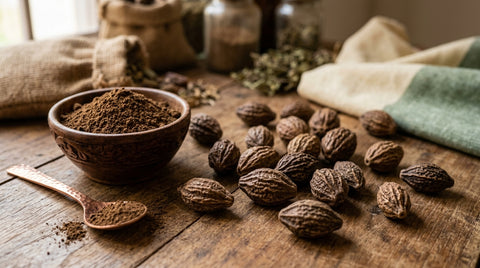
Ratanjot (Alkanet Root): Benefits, Uses, Side Effects and How to Identify It
Ratanjot (alkanet root) is a traditional Ayurvedic herb prized for its deep red-purple pigment. Learn its medicinal uses for skin, hair and digestion, how to identify genuine roots, how to use in food and oil, and what the safety concerns are.
Ratanjot is the common Hindi name for the dried roots of plants in the Arnebia, Onosma or Alkanna genera, valued for their intense red-purple pigment (shikonin and alkannin compounds). Traditionally used in Ayurvedic skin care, hair oils and Kashmiri cooking, ratanjot root is applied externally to support skin health and wound healing. Oral use in large amounts is not recommended. For culinary use in authentic Kashmiri dishes, the roots are briefly infused in hot ghee to extract the colour.
- Ratanjot (alkanet root) contains shikonin and alkannin — naturally occurring pigments with traditional antimicrobial and wound-healing properties used in Ayurvedic skin care.
- The red-purple colour ratanjot imparts to oils and ghee has made it a traditional food colourant in Kashmiri cuisine (Rogan Josh, Kashmiri pulao) for centuries.
- Ratanjot is found mainly in the Himalayan regions of India — Jammu & Kashmir, Himachal Pradesh and Uttarakhand — and in Rajasthan.
- For external use in hair and skin oils, ratanjot is traditionally considered safe; oral use at high doses is not recommended due to pyrrolizidine alkaloid content.
- The correct botanical identification matters: food-grade ratanjot used in Indian cooking (Arnebia sp. or Onosma sp.) is different from the European alkanet (Alkanna tinctoria) commonly sold online.
What is ratanjot (alkanet root)?
The name "ratanjot" (sometimes written ratan jot or ratan jyot — literally "jewel of light") is applied in Indian trade to the dried roots of several related plant species from the borage family (Boraginaceae). The most commonly sold varieties in India are:
- Arnebia euchroma (Royle) Johnston — the Himalayan alkanet, primarily from Kashmir and Himachal Pradesh; the most prized food and medicinal grade.
- Onosma bracteatum Wall. — found in the Himalayan foothills; used in Ayurvedic preparations.
- Alkanna tinctoria (L.) Tausch — the European alkanet; widely sold in Western herbal markets but not the traditional Indian food variety.
All three contain shikonin and alkannin — the naphthoquinone pigments that give the roots their distinctive red-purple colour and their traditional medicinal properties. The roots are dried, then infused in oil, ghee or water to extract the pigment and bioactive compounds.
Names of ratanjot in different languages
| Language | Name |
|---|---|
| Hindi | Ratanjot, Ratan Jot, Ratan Jyoth |
| Sanskrit | Ratanjyot, Arnebiya |
| Kashmiri | Ratanjoth |
| Urdu | Ratanjot |
| English | Alkanet Root, Himalayan Alkanet, Dyer's Alkanet |
| Botanical (Himalayan) | Arnebia euchroma |
| Botanical (Indian plains) | Onosma bracteatum |
| Botanical (European) | Alkanna tinctoria |
| Family | Boraginaceae |
How to identify genuine ratanjot
Adulteration and mislabelling are common with ratanjot because the colour pigment is commercially valuable. Here is what to look for:
- Colour test: Genuine ratanjot root should immediately bleed a vivid red-purple colour when placed in warm oil or warm water. Very slow or pale colour extraction suggests adulteration or old, degraded stock.
- Root form: Authentic dried roots are slender, rough-textured, with a dark reddish-brown outer bark and lighter interior. They should not be ground into fine powder in their raw state — fresh-ground roots are deep purple-red.
- Source labelling: For food-grade culinary use, look for roots sourced from Jammu & Kashmir or Himachal Pradesh and identified as Arnebia euchroma. For topical Ayurvedic use, any authentic Boraginaceae species from the region is acceptable.
- Smell: Fresh ratanjot has a faint earthy, slightly resinous smell. No strong artificial colour or chemical odour should be present.
- Avoid synthetic substitutes: Some vendors sell artificially coloured material or turmeric-based blends labelled as ratanjot for Kashmiri recipes. The absence of colour bleed in cold oil is a warning sign.
Medicinal uses of ratanjot in Ayurveda
Ratanjot has been documented in Indian folk medicine and Ayurvedic texts for a range of external and limited internal applications. The key traditional uses are:
Skin care and wound healing
Shikonin and alkannin — the principal compounds in ratanjot root — are traditionally associated with antimicrobial, anti-inflammatory and wound-healing properties. Ratanjot-infused oil was traditionally applied to minor burns, skin rashes, eczema and slow-healing wounds in Ayurvedic practice. It is a component of several classical Ayurvedic taila (medicated oil) and lepa (topical paste) formulations for skin conditions.
Hair oil and scalp care
Ratanjot-infused hair oil is a traditional preparation used in northern India and Kashmir for scalp nourishment and to support hair health. The oil is prepared by warming sesame or coconut oil with ratanjot roots until the oil turns deep red. This preparation is then massaged into the scalp. The shikonin compounds are associated with antimicrobial properties that may help maintain a healthy scalp environment. For a full guide, see our companion article ratanjot ke fayde.
Digestive support (traditional)
In classical Ayurveda and Unani medicine, small doses of ratanjot were used as a digestive tonic, particularly for intestinal complaints, mucous membrane conditions and as an astringent. This is an internal use that requires Ayurvedic guidance; it is not a routine over-the-counter application.
Joint and muscle pain (topical)
Ratanjot-infused oils have been used in folk medicine for warming massage on stiff or aching joints and muscles, combined with other herbs. The warming properties of the oil base and the shikonin compounds are considered jointly responsible for this traditional application.
How to use ratanjot in food
Ratanjot's most famous culinary use is as a natural food colourant in Kashmiri cuisine — particularly in Rogan Josh (the traditional red lamb curry), Kashmiri rice and certain yakhni dishes. The authentic deep-red colour of Rogan Josh traditionally comes from ratanjot, not from red chilli powder.
| Use | Method | Notes |
|---|---|---|
| Kashmiri Rogan Josh | 2–3 small roots heated in ghee for 2–3 minutes, then removed before adding meat | Provides the traditional deep-red colour; roots are discarded after colour extraction |
| Kashmiri rice / pulao | 1–2 roots in warming oil/ghee at the start of cooking | Imparts a subtle pink-red hue; not a strong flavour contributor |
| Hair oil preparation | Roots simmered in sesame or coconut oil until oil turns red; roots strained out | Topical use only; not for consumption |
| Skin oil / lepa | Roots infused in sesame oil with other herbs; applied externally | Traditional Ayurvedic preparation for skin support |
Important: Do not consume large amounts of ratanjot root directly or in decoction form without Ayurvedic guidance. The brief culinary infusion in hot ghee for colouring — where roots are removed — is the traditional food use. Prolonged or high-dose oral consumption of Boraginaceae species raises concern due to the presence of pyrrolizidine alkaloids (see safety section below).

What is Ratan Josh masala?
"Ratan Josh" masala is a commercial spice blend marketed in India and globally for making Kashmiri-style Rogan Josh. The name combines "Ratan" (from ratanjot, the colouring root) and "Josh" (from the dish name). These commercial blends may or may not contain actual ratanjot root — many use Kashmiri red chilli powder for colour instead, with the ratanjot name used as a marketing reference. For authentic flavour and colour, use whole ratanjot roots infused directly in ghee as described above.
In which Indian state is ratanjot found?
Ratanjot (Arnebia euchroma) grows wild in the high-altitude Himalayan regions, primarily in:
- Jammu & Kashmir: The most prized culinary and medicinal grade comes from the Kashmir Valley and Ladakh region.
- Himachal Pradesh: Found in alpine meadows above 2,500 metres.
- Uttarakhand: In the Kumaon and Garhwal Himalayan ranges.
- Rajasthan: Onosma bracteatum (the plains variety of ratanjot) grows in Rajasthan and neighbouring states.
Due to habitat pressure and collection demand, wild Himalayan ratanjot is becoming less available; sustainable cultivation is being promoted in Himachal Pradesh and Uttarakhand.
Comparison: ratanjot vs other natural food colourants
| Colourant | Colour Produced | Traditional Use | Notes |
|---|---|---|---|
| Ratanjot (Arnebia sp.) | Deep red-purple | Kashmiri cooking, Ayurvedic oil | Brief infusion in hot ghee; roots removed |
| Kashmiri red chilli | Bright red | Rogan Josh, curries | Spicy; different flavour profile |
| Turmeric | Yellow-gold | Widespread Indian cooking | No red pigment; different compound class |
| Beetroot powder | Pink-red | Modern food colouring | Not traditional in Kashmiri cuisine |
| Saffron | Golden-yellow | Kashmiri rice, sweets | Different pigment; used for golden colour not red |
Is ratanjot harmful? Safety and side effects
The safety profile of ratanjot depends on how it is used:
External use (skin oil, hair oil): Generally considered safe in traditional Ayurvedic practice. Patch test before first use on sensitive skin, as individual reactions to plant pigments can vary.
Culinary use (brief infusion in ghee, then roots removed): This is the traditional food use and is considered safe — the brief heat infusion extracts primarily the pigment into the cooking fat with minimal root matter consumed.
Oral consumption of roots directly (decoctions, powder in large amounts): This raises concern. Plants in the Boraginaceae family contain pyrrolizidine alkaloids (PAs) — compounds known to be hepatotoxic (toxic to the liver) in large doses or with prolonged use. European regulatory bodies have issued guidelines limiting PA intake from herbal products. High-dose or prolonged oral use of ratanjot is not recommended without qualified Ayurvedic guidance.
When to see a doctor
Ratanjot is a traditional topical and culinary herb. See a doctor if you experience:
- Skin irritation, redness or allergic reaction after topical application — discontinue use
- Any digestive symptoms (nausea, abdominal pain, jaundice) if you have been taking ratanjot orally in any substantial amount
- Any concerns about liver health — do not use ratanjot root orally if you have liver disease
Do not use ratanjot root orally during pregnancy or breastfeeding. Consult an Ayurvedic doctor before using it as an internal medicine for any condition.
Buy: Ratanjot (Alkanet Root)
Dhanyawad's Ratanjot Root (100 g, ₹285) is sourced from Himalayan regions, dried and packed without additives or artificial colour. Use it to prepare authentic Kashmiri dishes or to infuse your own ratanjot hair oil at home. For the full Hindi guide to ratanjot's traditional uses, see our article रतनजोत के फायदे. For Ayurvedic hair care, also read our guide to ayurvedic hair oil.
Frequently Asked Questions
What are the medicinal uses of ratanjot?
Ratanjot is traditionally used in Ayurveda for skin conditions (rashes, minor burns, eczema), scalp and hair care through oil infusions, as a digestive tonic in small doses, and in topical preparations for joint and muscle discomfort. The shikonin compounds in the root have shown antimicrobial and anti-inflammatory activity in laboratory studies.
How to use ratanjot in food?
The traditional method is to place 2–3 small dried roots in hot ghee or oil for 2–3 minutes until the fat turns deep red, then remove and discard the roots before adding other ingredients. This is the basis of authentic Kashmiri Rogan Josh and similar dishes. Do not grind or consume the roots in large quantities.
What is Ratan Josh masala?
Ratan Josh masala is a commercial Kashmiri-style spice blend named after ratanjot (ratan) and Rogan Josh (the dish). Commercial blends vary — some include actual ratanjot root, others use Kashmiri chilli for colour. For authentic colour and flavour, whole ratanjot roots infused in ghee are the traditional approach used in Kashmiri home cooking.
What is ratanjot called in English?
Ratanjot is called alkanet root or Himalayan alkanet in English. The Himalayan variety (Arnebia euchroma) used in Indian cooking and Ayurveda is also called arnebya or dyer's alkanet. The European variety (Alkanna tinctoria) is commonly sold online under the alkanet root name but is a different species from the traditional Indian food-grade ratanjot.
Is ratanjot harmful?
Brief use of ratanjot in cooking (infused in ghee, roots removed) and topical use in hair and skin oils are traditionally considered safe. High-dose oral consumption — decoctions or root powder in large amounts — is not recommended due to the presence of pyrrolizidine alkaloids, which can be hepatotoxic in large doses. Avoid oral use during pregnancy and breastfeeding.
In which Indian state is ratanjot found?
The prized Himalayan ratanjot (Arnebia euchroma) grows primarily in Jammu and Kashmir, Himachal Pradesh and Uttarakhand at high altitudes. The plains variety (Onosma bracteatum) is found in Rajasthan and neighbouring states. Wild Himalayan ratanjot is becoming less common due to over-collection; sustainable cultivation is being developed in hill states.
Can ratanjot be used for hair growth?
Ratanjot is traditionally used in hair oil for scalp nourishment and to support overall hair health. The shikonin compounds have demonstrated antimicrobial activity in laboratory studies, which may support a healthy scalp environment. However, ratanjot is not specifically documented in classical Ayurveda as a primary herb for hair growth; it is more associated with scalp skin conditions and colour. Bhringraj and amla remain the cornerstone herbs for hair growth in Ayurvedic tradition.
What does ratanjot taste like?
Ratanjot root has a mild earthy, slightly astringent taste. It does not contribute a strong flavour to dishes — its primary role in cooking is as a natural colourant. The red-purple pigment infuses into ghee or oil during brief heating without significantly altering the taste of the dish.
Sources
Written by the Dhanyawad Ayurved team and reviewed by Vaidya Ravinder Arora (40+ years), Dhanyawad Ayurved Vatika, Dwarka, New Delhi. This article describes traditional uses for general information. It is not medical advice. Consult a qualified doctor or Ayurvedic practitioner before using any herb therapeutically.