Kalonji in English: What It Is, How to Identify It and How to Use It
Kalonji in English is Nigella sativa — also called black seed or fennel flower seeds. This guide explains what kalonji is, how to identify it, its traditional uses, how to use it and who should avoid it.
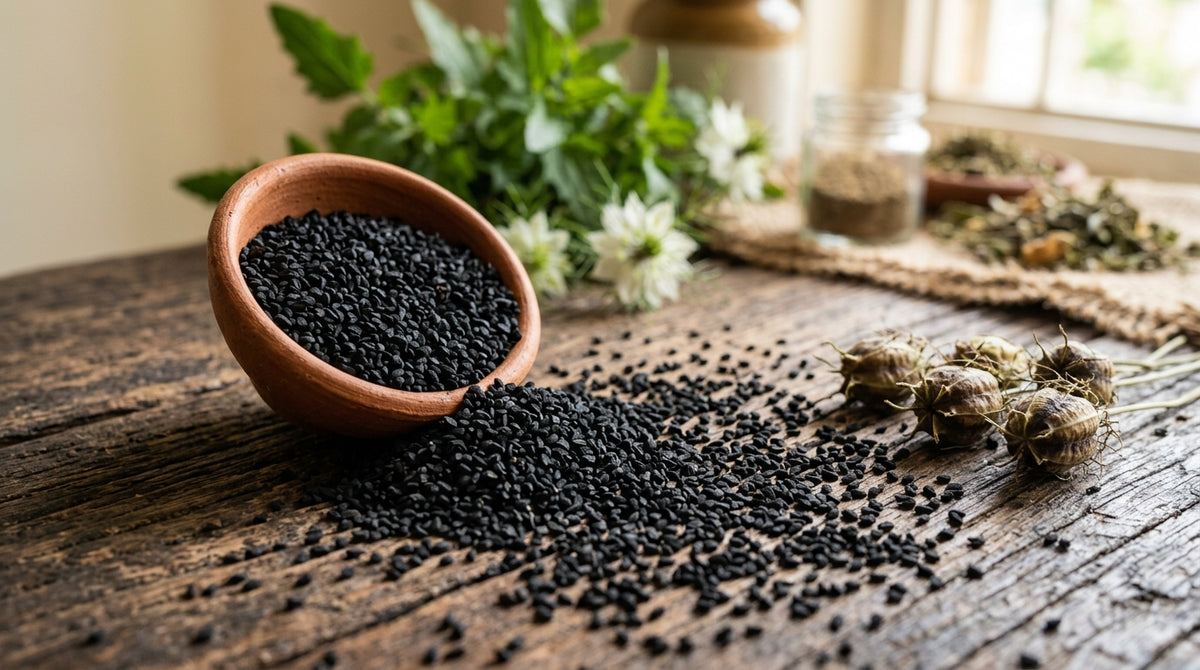
Kalonji in English is Nigella sativa — a small flowering plant in the family Ranunculaceae. Its seeds are sold under several English names: black seed, black cumin, fennel flower seeds, Roman coriander and onion seed. Despite the name "black cumin", kalonji is botanically unrelated to cumin (Cuminum cyminum) or caraway. It is one of the most extensively researched herbs in traditional medicine and is widely used in Indian, Middle Eastern and North African cooking and herbal practice.
- Kalonji in English is Nigella sativa — commonly called black seed, black cumin or fennel flower seeds; it is NOT the same as kala jeera (caraway) or black sesame.
- The small, matt-black, triangular seeds have a distinctive slightly bitter, peppery-herbal taste — if you bite one and get a bland or nutty flavour, it is likely black sesame, not kalonji.
- Kalonji has been used in Ayurveda and Unani medicine for centuries and contains thymoquinone, an active compound studied for its antioxidant and anti-inflammatory properties.
- The typical traditional dose is ½–1 teaspoon of seeds (1–3 g) daily; kalonji oil is used 1–2 teaspoons per day — do not exceed recommended amounts.
- People with diabetes, low blood pressure or on blood-thinning medication must consult a doctor before taking kalonji regularly as a supplement.
What is kalonji?
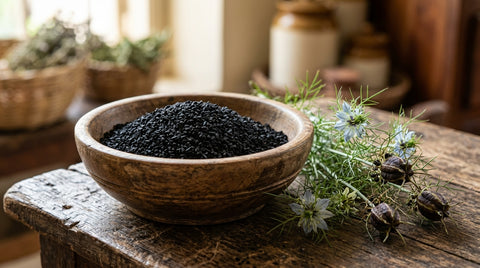
Kalonji is the small, matt-black, angular seed of the Nigella sativa plant — an annual flowering herb that grows to about 20–90 cm in height and produces pale blue-white flowers. The seeds develop inside balloon-like capsules. When the capsule dries, it splits open to release the hard, wrinkled seeds — each roughly 2–3 mm long, with a distinctive slightly bitter, peppery flavour and a faint aroma resembling a blend of onion, thyme and oregano.
The seeds contain thymoquinone (TQ), a bioactive compound that is responsible for much of the scientific interest in kalonji. They also contain fixed oils (linoleic acid, oleic acid), proteins, alkaloids (nigellicine, nigellidine), saponins, terpenes and a range of vitamins and minerals.
Kalonji: names in other languages
| Language / Context | Name |
|---|---|
| Hindi / Urdu | कलौंजी (Kalonji), कलौंजी के बीज |
| Sanskrit | कृष्णजीरक (Krishnajiraka), उपकुञ्चिका (Upakunchika) |
| English | Black Seed, Black Cumin, Fennel Flower, Roman Coriander, Onion Seed |
| Arabic | حبة البركة (Habbatus sauda — "seed of blessing") |
| Persian / Farsi | سیاه دانه (Siah Dana) |
| Bengali | কালোজিরা (Kalo Jira) |
| Tamil | கருஞ்சீரகம் (Karun Cheeragam) |
| Botanical name | Nigella sativa L. (family Ranunculaceae) |
How to identify genuine kalonji — and not confuse it with similar seeds
Kalonji is frequently confused with two other seeds in Indian markets: kala jeera (caraway, Carum carvi) and black sesame (Sesamum indicum var.). Here is how to tell them apart before you buy:
| Feature | Kalonji (Nigella sativa) | Kala Jeera / Caraway (Carum carvi) | Black Sesame (Sesamum indicum) |
|---|---|---|---|
| Shape | Small, 3-sided, irregular angular | Curved, crescent-shaped, ribbed | Flat, oval, smooth |
| Colour | Matt jet-black | Dark brown to black, lighter edges | Shiny jet-black |
| Taste | Bitter-peppery, slight onion-thyme note | Earthy, anise-like, sweet | Mild, nutty, buttery |
| Aroma | Pungent, herbal, slightly oregano-like | Strong anise / licorice-like | Very mild, nutty when toasted |
| Size | 2–3 mm, very small | 4–6 mm, elongated | 2–3 mm, flat and oval |
| Surface | Matt, slightly wrinkled | Ridged, five-ribbed | Smooth and glossy |
Quick field test: Bite into a single seed. Kalonji gives a sharp, peppery, herbal bitterness. If the flavour is bland or nutty, you likely have black sesame. If the aroma is strongly anise-like, it is caraway (kala jeera). Authentic kalonji should never taste sweet.
Traditional uses of kalonji in Ayurveda and Unani medicine
Kalonji has been used in traditional medicine for over 2,000 years. It is referenced in the ancient Ayurvedic texts as Krishnajiraka and holds an especially prominent place in Unani medicine. In Islamic tradition, it is referred to as the "seed of blessing." The Prophet's hadith (Sahih al-Bukhari) describes it as a "remedy for every disease except death" — a phrase that reflects its cultural importance, not a medical claim.
In Ayurveda, kalonji is classified as:
- Rasa (taste): Katu (pungent), Tikta (bitter)
- Virya (potency): Ushna (warming)
- Vipaka (post-digestive effect): Katu (pungent)
- Dosha action: Vata and Kapha pacifying
Classically, it is traditionally used to support digestion, ease bloating, help the respiratory system, support normal blood sugar levels, and as a general tonic. Topically, kalonji oil is applied to the scalp and skin in traditional practice.
What are kalonji seeds traditionally used for?
Digestive support
Kalonji seeds are a well-known carminative in Indian cooking — added to breads (naan, paratha), pickles and lentil dishes to reduce gas and bloating. The seeds' active compounds relax the smooth muscle of the intestinal wall. Traditional preparations include combining roasted kalonji powder with honey for an after-meal digestive tonic.
Respiratory system support
In both Ayurveda and Unani practice, kalonji is traditionally used for respiratory complaints. Steam inhalation using a few drops of kalonji oil in hot water, or a honey-kalonji mixture, are time-honoured home practices for nasal congestion and throat irritation. These are traditional comfort uses — they do not treat diagnosed respiratory conditions.
Blood sugar management support
Kalonji has been studied in people with type 2 diabetes. Several trials have examined black seed powder supplementation and reported modest improvements in fasting blood glucose markers. Important: if you have diabetes and take medication, consult your doctor before using kalonji as a supplement — it may interact with your prescribed treatment and cause blood sugar to drop too low. Do not stop or reduce any prescribed medication.
Antioxidant properties
Thymoquinone (TQ), the primary active compound in kalonji oil, has been extensively studied for its antioxidant activity. Antioxidants help protect cells from oxidative stress, which is associated with inflammation and chronic disease. This is an area of ongoing research — existing studies are largely animal or in vitro; large-scale human trials are limited.
Skin and hair support (topical use)
Kalonji oil is widely applied to the scalp as a traditional hair-support oil, often mixed with coconut or olive oil. For skin, it is used as a spot application for minor irritation. These are traditional uses supported by anecdotal evidence; it does not change skin colour and should not be presented as a "fairness" treatment.

How to use kalonji seeds and kalonji oil
| Form | Typical Use | Traditional Amount | Method |
|---|---|---|---|
| Whole seeds | In cooking (breads, pickles, curries) | ½–1 tsp per dish | Add to hot oil/ghee; use as tempering (tarka) |
| Seed powder | General wellness supplement | 1–3 g (≈½–1 tsp) daily | Mixed with honey or warm water; after meals |
| Kalonji oil | Topical (scalp/skin) or internal wellness | 1 tsp internally; apply as needed topically | With honey or warm water internally; massage into scalp |
| Honey + kalonji | Digestive and respiratory support | ½ tsp seeds + 1 tsp honey | Mix and take in the morning on an empty stomach |
Can you eat kalonji seeds every day?
In traditional practice, consuming 1–3 g (approximately ½ to 1 teaspoon) of kalonji seeds daily is considered a normal maintenance amount for healthy adults. Regular use at this level is well-established in culinary and herbal traditions. However, very high doses — above 5 g daily for extended periods — may cause stomach discomfort, and kalonji oil taken in excess has been reported to cause low blood pressure in some individuals. Always start with a small amount and increase gradually.
Who should avoid kalonji or consult a doctor first
- Pregnant women: Kalonji has traditionally been used to stimulate uterine contractions; it should be avoided in pregnancy except as a normal cooking spice in small amounts.
- Diabetes medication: Kalonji may lower blood glucose — discuss with your doctor to avoid hypoglycaemia.
- Blood pressure medication: Kalonji may reduce blood pressure; using it alongside antihypertensives warrants medical monitoring.
- Blood-thinning medication: Kalonji oil may have mild anticoagulant effects; consult your doctor if you take warfarin or similar medicines.
- Children under 5: Use only under medical guidance.
See a doctor if you develop any rash, breathing difficulty, severe stomach pain or dizziness after taking kalonji. These are rare but should not be ignored.
Kalonji seeds vs kalonji oil — which to use?
Whole seeds are the most versatile form — suitable for cooking and for making your own preparations at home. Kalonji oil is more concentrated (it takes around 400–500 g of seeds to press 100 ml of oil) and is convenient for topical scalp or skin use. For internal use, seed powder in honey or warm water is the most traditional Ayurvedic and Unani method; oil taken internally should be in small amounts (1 teaspoon) and not used in place of a balanced diet.
Where to buy kalonji and what it should cost
Dhanyawad Ayurved Kalonji (Nigella sativa) is 100% pure, whole black seeds — no additives, artificial fragrance or fillers. Available from Dhanyawad Ayurved Vatika, Sector 13, Dwarka, New Delhi, with pan-India shipping within 24 hours. Dhanyawad Ayurved Kalonji seeds are priced at ₹45 per 100 g; always check that the seeds are whole, uniform in colour and free from dust or chalky residue (signs of old stock).
Also read our Hindi guide: कलौंजी के फायदे, उपयोग और नुकसान।
Frequently Asked Questions
Is kalonji the same as black sesame?
No — kalonji (Nigella sativa) and black sesame (Sesamum indicum) are completely different plants. Kalonji seeds are 3-sided, matt-black, bitter and peppery. Black sesame seeds are flat, oval, shiny and mild with a nutty taste. They are not interchangeable, either in cooking or as a health supplement.
Is kalonji called kala jeera in Hindi?
Kalonji is sometimes loosely called "kala jeera" in some regions, but this is botanically incorrect and causes confusion in the market. True kala jeera (black caraway) is Carum carvi — a crescent-shaped, ribbed, anise-flavoured seed. Kalonji (Nigella sativa) is a separate species with a very different flavour profile and botanical family.
What are 10 traditional benefits of black seed (kalonji)?
Kalonji is traditionally credited with supporting: (1) digestion and bloating relief, (2) respiratory comfort, (3) normal blood sugar levels (as a support, with doctor's advice), (4) blood pressure management support, (5) antioxidant protection, (6) skin and scalp health (topical), (7) immune system support, (8) joint comfort, (9) liver health support and (10) general immunity. These are traditional uses; they do not constitute medical treatment claims.
Can I eat kalonji seeds daily?
Yes — 1–3 g (½ to 1 teaspoon) of kalonji seeds daily is a conventional amount used in culinary and herbal traditions for healthy adults. People with diabetes, low blood pressure or those taking blood-thinning medicines should consult their doctor before making kalonji a regular supplement.
How do you use kalonji for hair?
The most common traditional method is to warm a small amount of kalonji oil and massage it into the scalp, leaving it for 30–60 minutes before washing. It is often mixed with an equal part of coconut oil. This is a traditional scalp nourishment practice — it supports hair and scalp health but does not "cure" alopecia or pattern baldness, which require medical evaluation.
Is kalonji good for the liver?
Animal studies have shown thymoquinone (the active compound in kalonji) to have hepatoprotective properties — meaning it may help protect liver cells from certain toxins. Human studies are limited. This is a promising area of research, not a proven medical use. For diagnosed liver conditions, consult a doctor and do not replace prescribed treatment with kalonji.
Sources
Written by the Dhanyawad Ayurved team and reviewed by Vaidya Ravinder Arora (40+ years), Dhanyawad Ayurved Vatika, Dwarka, New Delhi. This article describes traditional uses for general information. It is not medical advice. Consult a qualified doctor or Ayurvedic practitioner before using any herb therapeutically.