Dalchini in English: What Cinnamon Is, How to Identify and Use It
Dalchini in English is cinnamon — the aromatic bark of Cinnamomum verum or C. cassia. This guide covers identification, uses, correct dose and who should avoid it.
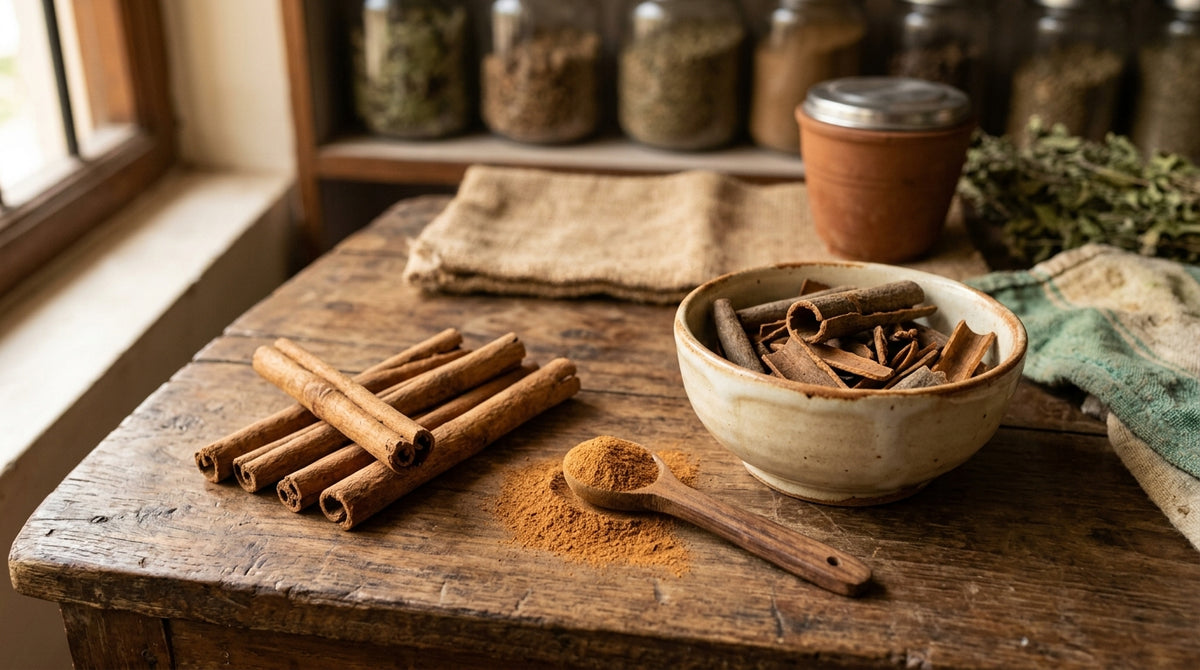
Dalchini in English is cinnamon — the aromatic dried inner bark of trees in the Cinnamomum genus. Two species dominate the market: Cinnamomum verum (Ceylon cinnamon, considered true cinnamon) and Cinnamomum cassia (Cassia, the more common variety in Indian pansaris). In Ayurveda, dalchini is known as tvak (meaning "bark") and has been used for thousands of years for digestion, blood sugar support and as a warming spice.
- Dalchini in English is cinnamon — the dried inner bark of trees in the Cinnamomum genus, primarily Cinnamomum verum (Ceylon/true cinnamon) and Cinnamomum cassia (Cassia cinnamon).
- Ceylon cinnamon (C. verum) is milder, sweeter and safer for regular use; Cassia (C. cassia) is more common in Indian markets and stronger-flavoured but contains more coumarin.
- Dalchini is traditionally used in Ayurveda as "tvak" for digestive support, blood sugar management assistance and warming the body.
- The safe daily amount for adults is 1–3 g (roughly ½–1 teaspoon of powder); higher doses of Cassia cinnamon may affect the liver due to coumarin content.
- People with diabetes, liver conditions or on blood-thinning medication must consult a doctor before taking dalchini as a supplement.
What is dalchini?
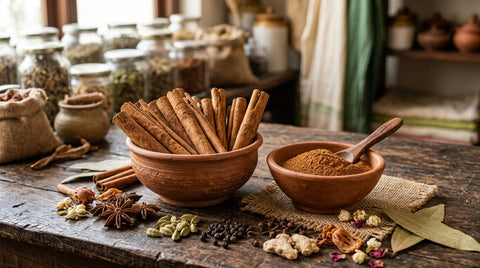
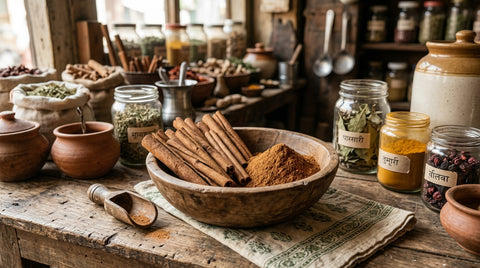
Dalchini is made from the inner bark of Cinnamomum trees. The bark is stripped from branches, the outer rough layer is removed, and the thin inner bark is left to dry. As it dries, it curls naturally into the familiar quills (sticks) we recognise as cinnamon. The same bark ground into powder becomes dalchini powder. Cinnamon's warm, sweet-spicy aroma comes primarily from cinnamaldehyde, a volatile compound that makes up 50–90% of the essential oil in the bark.
Dalchini: names in other languages
| Language / Context | Name |
|---|---|
| Hindi | दालचीनी (Dalchini) |
| Sanskrit | त्वक् (Tvak), वरांगा (Varanga) |
| English | Cinnamon, True Cinnamon (Ceylon), Cassia |
| Urdu / Persian | دارچینی (Darchini) |
| Tamil | இலவங்கப்பட்டை (Ilavangappattai) |
| Telugu | దాల్చినచెక్క (Dalchina chekka) |
| Marathi | दालचिनी (Dalchini) |
| Botanical name | Cinnamomum verum (Ceylon) / C. cassia (Cassia) |
Is dalchini the same as cassia?
This is one of the most common questions about cinnamon. The short answer: both are types of cinnamon, but they are different plants. In India, most of what is sold as "dalchini" in pansaris and grocery shops is C. cassia (Cassia cinnamon), which is cheaper and more widely available. True Ceylon cinnamon (C. verum) is more expensive and mainly produced in Sri Lanka. Both are used as spice and in Ayurveda, but there are important practical differences.
How to identify genuine dalchini — Ceylon vs Cassia
| Feature | Ceylon Cinnamon (C. verum) | Cassia Cinnamon (C. cassia) |
|---|---|---|
| Stick appearance | Thin, multiple tightly wound layers, like a cigar | Thick, single or double layer, hollow quill |
| Colour | Light tan to pale brown | Dark reddish-brown |
| Taste | Delicate, slightly sweet, mild | Strong, slightly bitter, pungent |
| Smell | Gentle, floral-sweet aroma | Strong, sharp, spicy aroma |
| Coumarin level | Very low (≈0.001–0.014%) | High — significantly more than Ceylon; relevant at supplemental doses |
| Price | Significantly higher | Lower, widely available |
| Best for | Regular supplemental use, high-dose use | Everyday cooking, occasional use |
If you are using dalchini regularly as a health supplement (more than 1 teaspoon daily), Ceylon cinnamon is the safer choice because of its much lower coumarin content. For everyday cooking in moderate amounts, Cassia is fine. पढ़ें हमारी हिंदी गाइड: दालचीनी के फायदे।
Traditional uses of dalchini (Ayurvedic and culinary)
In Ayurveda, tvak (dalchini) is classified as katu (pungent), tikta (slightly bitter), ushna (warming in potency) and laghu (light to digest). It is used as a:
- Deepana: Kindles digestive fire — stimulates digestive enzymes and helps break down food efficiently.
- Pachana: Digestive — helps digest ama (undigested metabolic waste).
- Vatahara and Kaphahara: Traditionally reduces excess vata (gas, bloating) and kapha (congestion, sluggishness).
Modern research echoes some of these traditional uses. A PMC study on cinnamon and insulin resistance found that cinnamon supplementation was associated with improvements in fasting blood glucose in several trials, though results across studies vary. NCCIH notes that the evidence for cinnamon as a blood sugar supplement is mixed and that it should not replace prescribed diabetes treatment.
Digestion and gut health
Dalchini is one of the most widely used digestive spices in Indian cooking — added to biryanis, daals, masala chai and festive rice dishes partly for flavour and partly for its digestive-stimulating properties. Cinnamaldehyde relaxes smooth muscle in the intestinal wall and reduces the frequency of cramps, gas and bloating. A pinch of dalchini in warm water or milk after a heavy meal is a traditional digestive support used across India.
Blood sugar management support
Dalchini may support insulin sensitivity and help moderate post-meal glucose spikes. Several clinical trials have studied cinnamon supplementation in people with type 2 diabetes or prediabetes, with mixed but generally modest positive results on fasting blood glucose. Important: this is a supportive role — dalchini is not a treatment for diabetes, and if you are on diabetes medication, starting a cinnamon supplement can lower your blood sugar further. Always consult your doctor before using dalchini medicinally for blood sugar.
Immunity and anti-microbial properties
Cinnamaldehyde has demonstrated anti-microbial activity against several bacterial and fungal strains in laboratory studies. Dalchini-ginger-honey tea (a traditional Indian kadha) remains a popular home remedy for early-stage colds, sore throats and mild seasonal illness. It is a warming, comforting support — not a prescription antiviral.

How to use dalchini — daily dose and methods
| Form | Daily amount | How to use |
|---|---|---|
| Dalchini powder | ½–1 teaspoon (1–3 g) | Stir into warm milk, water, porridge or smoothie |
| Dalchini stick (quill) | 1 stick (≈3–5 cm) in cooking | Add to tea, rice, dal or curry |
| Dalchini tea | ½ tsp powder or 1 small stick | Steep in 200 ml hot water for 10 min, strain and sip |
| Masala chai | Small piece added to chai pot | With ginger and cardamom for a warming digestive tea |
Dalchini powder vs dalchini stick — which is better?
Both are useful; the best form depends on how you want to use it. The powder absorbs faster and is easier to measure for supplemental use. The stick retains its volatile oils longer and is better for steeping in liquids or adding to slow-cooked dishes. For raw herb use at home, the stick or whole bark is fresher over time (seal in an airtight container). For convenience, powder is practical. Dhanyawad Ayurved's Dalchini | Cinnamon is available in both 100 g raw stick (₹120) and 100 g powder (₹120) at our Dwarka, Delhi store and online.
Which type of dalchini is best?
For everyday cooking in Indian food, Cassia is traditional and fine. For regular use as a health supplement — particularly if you intend to take ½–1 teaspoon daily for weeks or months — Ceylon cinnamon is safer because its coumarin content is significantly lower. In practice, the dalchini sold by trusted Indian pansaris is Cassia. In moderate culinary amounts it is safe for most healthy adults.
Who should not eat dalchini — safety and side effects
- Diabetes medication: Dalchini may lower blood sugar further. If you take insulin or oral hypoglycaemics, monitor your blood sugar and consult your doctor before adding a cinnamon supplement.
- Liver conditions: High-dose Cassia cinnamon contains coumarin, which can stress the liver at supplemental doses. People with liver disease should use only Ceylon cinnamon and in modest amounts.
- Blood-thinning medication: Cinnamon has mild blood-thinning effects. People on warfarin or other anticoagulants must consult their doctor.
- Pregnancy: Culinary amounts used in cooking are generally safe. Medicinal supplemental doses are best avoided in pregnancy — consult your doctor.
- Mouth sores: Concentrated cinnamon oil or cinnamon-flavoured products can cause mouth ulcers in sensitive individuals.
Is it safe to eat cinnamon every day?
Yes, for most healthy adults, using dalchini in cooking daily — a pinch in tea or a small stick in dal — is safe and traditional. The concern arises only at supplemental doses (more than 1–2 teaspoons/day) over long periods, particularly with Cassia cinnamon and its coumarin content. Switching to Ceylon cinnamon for regular supplemental use is a reasonable precaution. Do not use dalchini medicinally without consulting a doctor if you have diabetes, liver issues, or are on medication.
When to see a doctor
Dalchini is a food and a traditional herb — not a medicine. See a doctor if:
- You have diabetes, liver disease or are on anticoagulants and want to use dalchini regularly as a supplement.
- You develop mouth sores, skin rash or any allergic reaction after consuming cinnamon.
- You are using cinnamon to manage blood sugar and your glucose levels change unexpectedly.
- You are pregnant and want to use dalchini beyond normal culinary amounts.
Frequently Asked Questions
Who should not eat dalchini?
People with liver disease, those on blood-thinning medication (warfarin), people taking diabetes medication, and pregnant women in supplemental doses should either avoid or use dalchini only after consulting a doctor. In normal cooking amounts, dalchini is safe for most people.
Is dalchini the same as cassia?
No — dalchini broadly refers to cinnamon and includes both Ceylon (C. verum) and Cassia (C. cassia) varieties. In Indian markets, most dalchini sold is Cassia. True Ceylon cinnamon is milder, has much less coumarin and is considered "true" cinnamon by botanists, but both are used as dalchini in Indian cooking.
Is dalchini good for diabetes?
Some clinical studies suggest that cinnamon supplementation may modestly improve fasting blood glucose and insulin sensitivity in people with type 2 diabetes. However, evidence is mixed, and dalchini is not a treatment for diabetes. It should never replace prescribed medication. If you want to use it as a supplement alongside your medication, consult your doctor first — it may lower your blood sugar further than expected.
Which type of dalchini is best?
Ceylon cinnamon (C. verum) is best for regular supplemental use because of its very low coumarin content. Cassia is fine for everyday Indian cooking. If you use dalchini only as a cooking spice, Cassia is traditional and widely available. If you intend to take a teaspoon daily as a supplement, choose Ceylon.
Is it safe to eat cinnamon every day?
In culinary amounts (a pinch to a small stick in a day's cooking), yes — it is safe and traditional for most healthy adults. At higher supplemental doses of Cassia cinnamon over long periods, the coumarin content may affect the liver. Healthy adults taking up to 1 teaspoon of Cassia daily are generally not at risk, but switching to Ceylon for daily high-dose use is a sensible precaution.
Which type of cinnamon is healthiest?
Ceylon cinnamon (C. verum) is generally considered the healthiest because it contains very little coumarin. Both types have similar levels of cinnamaldehyde, which drives most of cinnamon's reported health properties. For maximum safety alongside maximum health benefit — particularly for regular supplemental use — Ceylon cinnamon is the better choice.
Sources
Written by the Dhanyawad Ayurved team and reviewed by Vaidya Ravinder Arora (40+ years), Dhanyawad Ayurved Vatika, Dwarka, New Delhi. This article describes traditional uses for general information. It is not medical advice. Consult a qualified doctor or Ayurvedic practitioner before using any herb therapeutically.