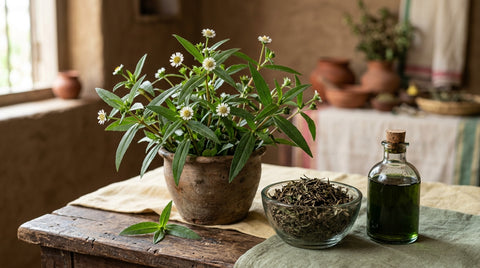
Bhringraj Benefits: Uses, How to Take, Dose and Side Effects
Bhringraj (Eclipta prostrata) is Ayurveda's premier hair herb — learn its proven traditional uses for hair, scalp, liver and skin, the correct dose, how to make bhringraj oil at home, and who should avoid it.
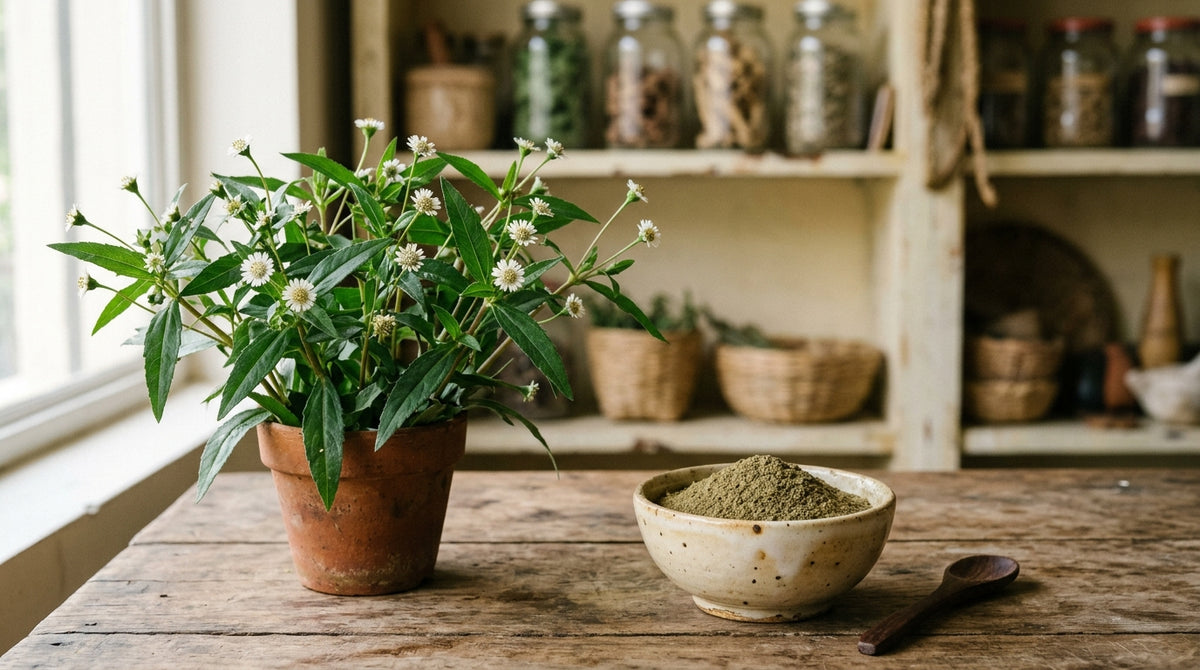
Bhringraj (Eclipta prostrata, also called False Daisy) is one of Ayurveda's most important rasayana herbs. It is traditionally used to nourish hair roots, support scalp health, maintain liver function and reduce stress-related symptoms. It is a supportive herbal product — not a medical treatment for hair loss or liver disease.
- Bhringraj (Eclipta prostrata, False Daisy) is traditionally considered the "king of herbs for hair" in Ayurveda — used to nourish hair roots, support scalp health and reduce hair fall.
- Both the powder (internal / hair mask) and the oil (scalp massage) are used; combine them for best traditional results — oil massage 2–3 nights/week + 1 g powder daily.
- Bhringraj also has a strong Ayurvedic tradition as a liver tonic and nervine — traditionally used to support normal liver function and reduce stress-related hair loss.
- Pregnant women and those on liver medications should consult a doctor before internal use of bhringraj.
- Dhanyawad Ayurved Bhringraj (₹95 / 100g) is pure Eclipta prostrata, no additives, available at Dwarka and across India.
What Is Bhringraj?
Bhringraj is a small, creeping annual plant in the daisy family (Asteraceae) that grows wild in moist, shaded soils across India, South-East Asia and tropical America — along riverbanks, paddy field borders and drainage channels. Its scientific name is Eclipta prostrata (formerly classified as Eclipta alba). In Sanskrit, bhringraj means "king of bees" or, more evocatively, "king of herbs that impart a dark lustre" — a reference to the dark juice its fresh leaves release when crushed.
Ayurveda classifies bhringraj under the rasayana (rejuvenative) category and lists it as keshya (hair-nourishing) and yakriduttejak (liver-supporting). Classical texts including Charaka Samhita and Ashtanga Hridayam mention it specifically for hair, skin and eye care.
Names in Other Languages
| Language / Region | Name |
|---|---|
| Sanskrit | Bhringraj, Keshraj, Markav, Tekaraj |
| Hindi | Bhangra, Bhringraj |
| English | False Daisy, Yerba de Tago |
| Botanical | Eclipta prostrata (syn. Eclipta alba) |
| Tamil | Karisalankanni (கரிசலாங்கண்ணி) |
| Telugu | Gunta Galaijeru (గుంటగలిజేరు) |
| Marathi | Maka, Bhringraj |
| Bengali | Keshuti (কেশুতি) |
How to Identify Genuine Bhringraj
Adulteration is common in the herbal market. Identifying authentic bhringraj:
- Leaves: Lance-shaped (lanceolate), 2–8 cm long, rough texture, slightly toothed edges.
- Stem: Prostrate or slightly ascending, green or reddish, covered with fine white hairs.
- Flowers: Small, white, 6–8 mm diameter, daisy-like — this gives the plant its English name "False Daisy".
- Juice test: Crush a fresh leaf — the juice darkens to black within minutes. This is the most reliable identification marker and the origin of the name (bhrunga = black bee).
- Powder: Authentic dried powder is deep olive-green to brownish-green with a grassy, slightly bitter smell. Pale yellow or off-white powder likely indicates adulteration or old stock.
Two varieties exist in Ayurvedic practice: white bhringraj (Eclipta prostrata — white flowers, widely available) and yellow bhringraj (Wedelia calendulacea — yellow flowers, rarer). White bhringraj is the standard commercial variety.
Bhringraj Benefits for Hair
Nourishes Hair Roots and Reduces Hair Fall
The most celebrated traditional use of bhringraj is for hair. Ayurveda's concept of keshavardhan (hair nourishment) and keshya (hair tonic) converge in bhringraj. Its active compounds — coumestans (wedelolactone), flavonoids and triterpenoids — support scalp circulation and hair follicle nutrition when applied topically. Regular oil massage is traditionally associated with reduced hair fall and improved hair texture.
Supports Scalp Health and Reduces Dandruff
Bhringraj is traditionally considered to have antifungal properties. Dandruff (seborrhoeic dermatitis) is partly driven by the Malassezia fungus; applying bhringraj oil or paste to the scalp is a traditional approach to support scalp microbiome balance. Note: clinical anti-dandruff shampoos (ketoconazole, selenium sulphide) are the evidence-based first-line option for moderate to severe dandruff.
Does Bhringraj Really Regrow Hair?
Traditional Ayurvedic texts classify bhringraj as a hair growth promoter, not a hair regrowth drug in the pharmaceutical sense. Laboratory studies on Eclipta prostrata extracts have shown hair follicle-stimulating activity in animal models, but robust human clinical trials remain limited. Consistent topical use (scalp oil massage, 2–3 times/week) over 8–12 weeks is the traditional protocol. If hair loss is sudden, patchy, or severe, a dermatologist evaluation is necessary — conditions like alopecia areata or androgenic alopecia require targeted medical treatment.
Delays Premature Greying
Ayurveda lists bhringraj under keshranjanam — herbs that help maintain natural hair pigmentation. Traditional practice recommends regular scalp massage with bhringraj-infused oil to support melanocyte health. This is a supportive use claim; bhringraj does not chemically reverse grey hair.
How Long Does Bhringraj Take to Work?
Rasayana herbs in Ayurveda are intended for sustained use, not quick fixes. Traditional protocols suggest 4–8 weeks of consistent topical use before changes in hair texture become apparent, and 8–12 weeks for meaningful reduction in hair fall. Internal use (powder or tablet) as a complement typically follows a 30–60 day course. Results vary significantly with diet, stress levels and the underlying cause of hair concerns.

Bhringraj Benefits Beyond Hair
Liver Support (Traditional Use)
In Ayurveda, bhringraj is classified as yakriduttpejak — stimulating to the liver. It is traditionally used to support normal liver function, aid the body's natural detoxification pathways and support bile secretion. If you have liver disease, hepatitis, fatty liver or are on liver medications, do not take bhringraj supplements without consulting your doctor. This is a traditional-use claim, not a clinical liver treatment.
Stress and Sleep Support
Bhringraj is considered a mild nervine (nerve tonic) in Ayurvedic practice. Head massage with bhringraj oil before sleep is a classical recommendation for reducing mental fatigue and supporting restful sleep. It is used alongside other nervines like brahmi and ashwagandha for stress-related hair loss management.
Is Bhringraj Edible?
Yes — bhringraj is edible. In some regions of India and South-East Asia, the young leaves are eaten as a pot herb or added to lentil dishes. The powder (1–3 g) is also taken internally, traditionally with honey, warm water or milk. The fresh juice is used in some classical formulations. Internal use in therapeutic doses should be with practitioner guidance.
What Are the Uses of Bhringraj Powder?
| Use | Method | Amount |
|---|---|---|
| Internal (general support) | Mix in warm water or honey | 1–3 g once or twice daily; practitioner guidance |
| Hair mask | 2–3 tsp powder + yoghurt or coconut oil → paste | Apply to roots; leave 30–45 min; wash off |
| Homemade bhringraj oil | 50 g powder in 200 ml sesame oil; simmer 30–40 min; strain | Massage into scalp 2–3 times/week; leave overnight |
| Skin support | Powder + rosewater → paste; apply to skin; wash after 20 min | Use 2–3 times/week as a traditional skin pack |
Bhringraj Oil vs. Bhringraj Powder — Raw vs. Powder
| Bhringraj Powder | Bhringraj Oil | |
|---|---|---|
| Best for | Internal use, hair masks, making your own oil | Ready-to-use scalp massage |
| Shelf life | 12–18 months sealed; 6 months after opening | 9–12 months; depends on base oil |
| Versatility | High — used both internally and externally | External only |
| Cost per use | Lower | Higher; depends on brand |
| Quality check | Colour (dark green), smell (grassy), no filler | Check base oil; should not smell rancid |
Dhanyawad Ayurved sells pure bhringraj in both raw (dried herb, ₹95/100g) and powder (₹95/100g) forms.
Dhanyawad Ayurved Bhringraj — Where to Buy
Dhanyawad Ayurved Bhringraj (₹95 / 100g) is pure Eclipta prostrata — no synthetic dyes, no fillers, no preservatives. Available in both raw and powder forms at Dhanyawad Ayurved Vatika, Sector 13, Dwarka, New Delhi, and shipped across India within 24 hours. For the Hindi deep-dive on bhringraj, read our Bhringraj ke Fayde article.
Related posts: Baal Jhadna Kaise Rokein — causes of hair fall and Ayurvedic approach | Ayurvedic Hair Oil Guide — bhringraj, amla and brahmi combinations.
Safety — Who Should Avoid Bhringraj?
- Pregnancy: Internal bhringraj use is not recommended during pregnancy without an Ayurvedic physician's guidance — insufficient safety data.
- Liver disease / liver medications: May interact with hepatic drug metabolism. Consult your doctor before starting.
- Blood-thinning medications: Bhringraj may affect clotting mechanisms — caution with anticoagulants (warfarin, aspirin therapy).
- Children under 12: Internal use only with paediatric Ayurvedic guidance.
- Topical allergy: Do a patch test on inner wrist before applying to the scalp — allergic contact dermatitis is possible.
See a doctor if: hair loss is sudden, patchy or associated with scalp pain; if you notice jaundice (yellowing), persistent fatigue, or abdominal pain; or if you develop any reaction after taking bhringraj internally.
Frequently Asked Questions
How long does bhringraj take to work?
Traditional protocols recommend 4–8 weeks of consistent topical use (oil massage 2–3 times/week) before changes in hair texture are noticeable. For meaningful reduction in hair fall, allow 8–12 weeks. Internal powder use for liver or stress support is typically taken for 30–60 day courses.
Does bhringraj reduce dandruff?
Bhringraj is traditionally considered supportive for scalp health, including dandruff associated with dryness and scalp imbalance. Apply bhringraj oil 1–2 hours before washing. For moderate to severe fungal dandruff, use an evidence-based anti-dandruff shampoo alongside the oil as a complementary approach.
Does Bhringraj really regrow hair?
Traditional Ayurvedic use classifies bhringraj as a hair growth promoter through scalp nourishment and follicle support. Lab studies are encouraging but large human trials are lacking. Consistent 8–12 week use is the classical protocol. Conditions like androgenic alopecia or alopecia areata need dermatologist assessment — bhringraj alone is not sufficient.
What are the uses of Bhringraj powder?
Bhringraj powder is used for: (1) hair masks — mixed with yoghurt or coconut oil applied to scalp; (2) homemade bhringraj oil — simmered in sesame oil; (3) internal use — 1–3 g with honey or warm water for liver and stress support; (4) skin packs — mixed with rosewater and applied topically.
Who should avoid Bhringraj?
Pregnant women (internal use), people on liver medications or anticoagulants, and children under 12 (internal use) should consult a doctor before taking bhringraj. People with sensitive skin should patch-test before scalp application.
Is bhringraj good for the liver?
In Ayurveda, bhringraj is classified as a liver tonic (yakriduttejak) and is traditionally used to support normal liver function. This is a traditional-use claim. If you have diagnosed liver disease or are on liver medications, consult your doctor before use — do not stop prescribed medications.
Bhringraj benefits for females specifically?
Bhringraj is commonly used by women for postpartum hair fall (a common hormonal concern), stress-related thinning and scalp dryness. The traditional internal use includes liver support which may be relevant for women experiencing hormonal fluctuations. Pregnant and nursing women should consult a practitioner before internal use.
Sources
Written by the Dhanyawad Ayurved team and reviewed by Vaidya Ravinder Arora (40+ years), Dhanyawad Ayurved Vatika, Dwarka, New Delhi. This article describes traditional uses for general information. It is not medical advice. Consult a qualified doctor or Ayurvedic practitioner before using any herb therapeutically.