
Kutki Benefits – Picrorhiza kurroa Uses, Dose and Side Effects
Kutki (Picrorhiza kurroa) is a rare Himalayan herb used in Ayurveda for liver support, digestion and fever management. Learn how to identify it, how to use it and who should exercise caution.
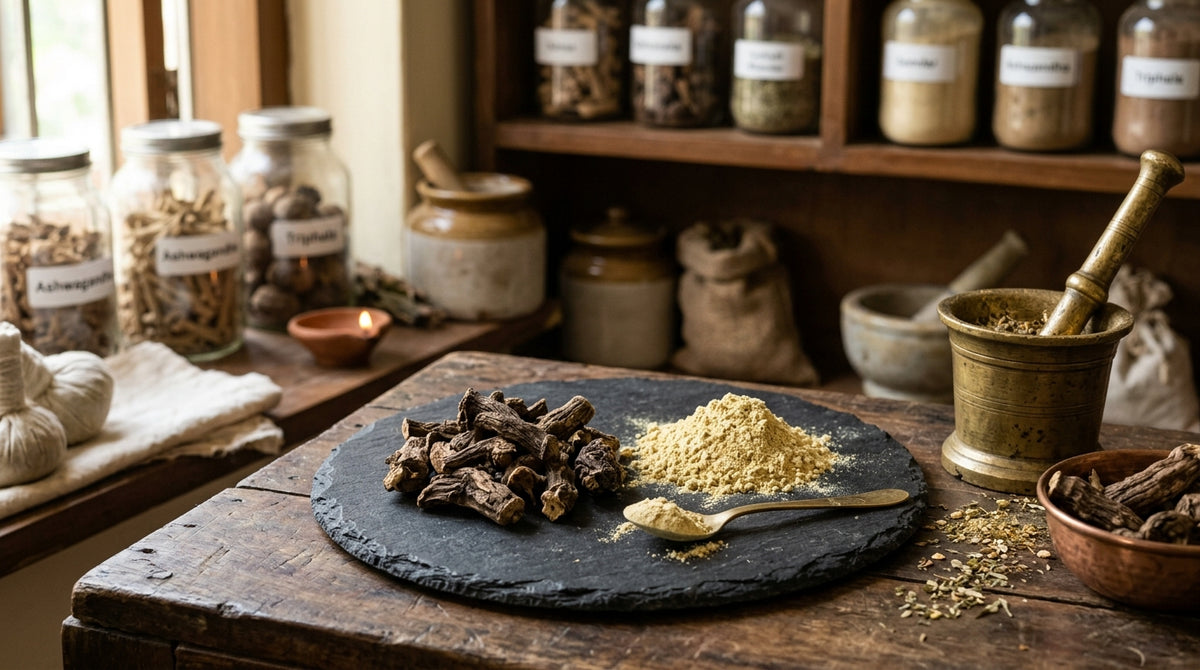
Kutki (Picrorhiza kurroa) is a small perennial alpine herb from the Himalayas whose roots and rhizome have been used in Ayurveda for centuries. It is classified as tikta (bitter), laghu (light) and ushna virya (heating) — primarily used as a liver tonic, digestive bitter, fever herb and anti-catarrhal. Dhanyawad Ayurved sells kutki root and powder for traditional use.
- Kutki (Picrorhiza kurroa) grows wild on rocky Himalayan slopes at 3,000–5,000 m; its roots and rhizome are the medicinal parts used in Ayurveda.
- Traditional uses include liver support, bitter digestive stimulation, fever management and respiratory catarrh (kapha conditions).
- Kutki is not the same as chirata (Swertia chirata) — both are bitter Himalayan herbs but different species with different classical indications.
- Standard traditional dose is 250 mg–1 g of root powder twice daily with water; do not exceed recommended amounts.
- People with autoimmune conditions, those on immunosuppressants, pregnant women and children under 12 must consult a doctor before use.
What is Kutki (Picrorhiza kurroa)?
Kutki (Picrorhiza kurroa Royle ex Benth.) is a small, creeping perennial herb of the family Plantaginaceae found on rocky, alpine slopes of the Himalayas — primarily in Himachal Pradesh, Uttarakhand, Kashmir, Nepal and Sikkim — at altitudes between 2,700 and 4,500 metres. The plant rarely exceeds 15 cm in height; its leaves are small, spoon-shaped with toothed margins. The medicinal part is the dried root and rhizome, which is bitter, brownish-grey on the outside and pale yellow inside.
In classical Ayurvedic texts — Charaka Samhita and Ashtanga Hridayam — kutki (called katuki or katuka) is listed among the leading tikta dravyas (bitter substances) alongside chirata and neem. Its intense bitterness is the primary pharmacological marker of quality.
Kutki names in different languages
| Language / Context | Name |
|---|---|
| Hindi / Market | Kutki, Katuki, Kadu (कुटकी, कटुकी) |
| Sanskrit / Ayurveda | Kaṭukā, Kaṭu rohiṇī, Tikta |
| English | Picrorhiza, Himalayan Hellbore (trade name), Kutki |
| Urdu / Unani | Karu (کٹو) |
| Tamil | Kadugurohini (கடுகுரோகிணி) |
| Marathi | Kutaki (कुटकी) |
| Botanical name | Picrorhiza kurroa Royle ex Benth. — family: Plantaginaceae |
| Part used | Root and rhizome (dried) |
How to identify genuine Kutki
Kutki is one of the most adulterated herbs in Indian markets because wild supplies are limited (the plant is endangered in many states). Key identification points:
- Taste: Intensely bitter — this is the clearest quality marker. Genuine kutki root has an unmistakable, prolonged bitterness. Weak or absent bitterness suggests adulteration or old/poorly stored stock.
- Colour: Fresh-ground powder is pale yellow to grey-brown. Bright yellow may indicate turmeric adulteration.
- Texture: Dry, hard root pieces. Powdered kutki should be fine and dry with no clumping.
- Source: Kutki from reputable pansaris who source directly from Himalayan regions. Dhanyawad Ayurved sources from established pansari-grade suppliers in Dwarka, New Delhi.
Traditional uses of Kutki in Ayurveda
1. Liver support — the most cited traditional use
In Ayurveda, kutki is classified as a yakrit-uttejaka (liver stimulant) and pittasaraka (bile-promoting) herb. It is traditionally used to support liver function and healthy bile flow. It appears in classical formulations for kamala (jaundice-like conditions) and liver congestion. Important: Kutki supports liver function — it does not treat liver disease. For fatty liver, hepatitis, cirrhosis or any diagnosed liver condition, follow your doctor's treatment and do not stop prescribed medication.
2. Digestive health — bitter tonic
As a potent bitter, kutki traditionally stimulates digestive secretions and appetite. It is used in Ayurveda for aruchi (loss of appetite), sluggish digestion and constipation with a dryness pattern. The bitterness acts as a digestive tonic in small doses. Caution: Large doses can cause loose stools and cramping — start with the minimum dose.
3. Fever management — traditional use
Kutki has been used in Ayurveda for jwara (fever) management — particularly intermittent and malarial-pattern fevers — often in combination with chirata and giloy. It is traditionally regarded as a detoxifying (shodhan) herb that helps clear heat and ama (metabolic waste) from the body. Do not use kutki to self-treat fever — always see a doctor for fevers that persist, are very high or are accompanied by severe symptoms.
4. Immune support
Some traditional texts describe kutki as a rasayana (rejuvenating) herb when used in small doses over time. It is included in Ayurvedic formulations for general immune health. People with autoimmune conditions or on immunosuppressant medications should consult a doctor before using kutki.
5. Respiratory support (kapha conditions)
Kutki is classified as kapha-pitta shamak (reducing excess kapha and pitta). Traditionally it is used in respiratory conditions characterised by excessive mucus or catarrh. It is sometimes combined with trikatu for respiratory kapha. For serious respiratory conditions, medical diagnosis and treatment come first.

Kutki vs Chirata — are they the same?
| Feature | Kutki | Chirata |
|---|---|---|
| Botanical name | Picrorhiza kurroa | Swertia chirata |
| Family | Plantaginaceae | Gentianaceae |
| Part used | Root and rhizome | Whole plant (aerial) |
| Primary taste | Intensely bitter | Intensely bitter |
| Main Ayurvedic use | Liver, kapha-pitta conditions, fever | Fever, blood purification, skin |
| Altitude | 3,000–5,000 m (alpine) | 1,200–3,000 m (sub-alpine) |
Both kutki and chirata are bitter Himalayan herbs but they are distinct species used for different primary indications in classical Ayurveda.
How to use Kutki powder — dose and method
| Use | Amount | Timing | With |
|---|---|---|---|
| Digestive / liver support | 250 mg – 1 g powder | Before meals, twice daily | Warm water |
| As a bitter tonic | ¼ tsp (approx. 500 mg) | Once daily before lunch | Honey + warm water |
| Raw root decoction | 2–3 g root pieces | Boiled in 200 ml water, reduced, strained | Drink warm |
Note: Do not exceed 1–2 g per day without guidance from a qualified Ayurvedic practitioner. The raw root is used to make decoctions; the powder mixes easily into water or honey. Consult your doctor before starting any herbal supplement.
Buy Kutki at Dhanyawad Ayurved
Dhanyawad Ayurved, Dwarka, New Delhi stocks Kutki (Picrorhiza kurroa) — raw root and powder — 100 g ₹450 each (raw root or powder). Pansari-grade quality, sourced from Himalayan suppliers. Related reading: कुटकी के फायदे हिंदी में · Triphala Powder Benefits · Arjuna Bark Benefits
Safety and precautions
- Autoimmune conditions: Kutki has immune-modulating properties in traditional use — people with autoimmune diseases (rheumatoid arthritis, lupus, etc.) or on immunosuppressant drugs should consult a doctor before use.
- Pregnancy and breastfeeding: Insufficient safety data — do not use kutki during pregnancy or breastfeeding without medical guidance.
- Liver disease: Kutki supports liver health in traditional use but is not a treatment — people with active liver disease must follow their doctor's advice and not self-medicate.
- Children under 12: Do not give kutki to children without a qualified practitioner's guidance.
- Excess dose: Large doses cause diarrhoea, cramping and nausea. Keep to recommended amounts.
See a doctor if: You have yellowing of skin or eyes, dark urine, persistent abdominal pain, severe nausea, or any unexplained fever that does not resolve — these warrant immediate medical assessment, not herbal self-treatment.
Frequently Asked Questions
What is Kutki good for?
Kutki is traditionally known for three main uses in Ayurveda: liver support and healthy bile flow, digestive stimulation as a bitter tonic, and fever management. It is also used in respiratory conditions with excess mucus (kapha) and as a general immune support herb in small doses over time.
How to take Kutki powder?
The standard traditional dose is 250 mg to 1 g (roughly ¼ teaspoon) of kutki root powder, taken before meals with warm water or honey twice daily. Start at the lower end of the dose and do not exceed 1–2 g per day without practitioner guidance. The raw root can also be simmered in water to make a decoction.
What is Kutki chirata?
Kutki and chirata are two separate herbs. Chirata (Swertia chirata) is from the gentian family and is used mainly for fever and blood purification in Ayurveda. Kutki (Picrorhiza kurroa) is from the plantain family and is primarily known for liver and digestive support. Sometimes both appear together in bitter formulations but they are distinct species.
Who should not take Kutki?
Pregnant women, breastfeeding mothers, children under 12, people with autoimmune diseases, and those on immunosuppressant or liver medications should not take kutki without consulting a doctor first. People with low blood pressure should also exercise caution.
What is the name of Kutki in homeopathy?
In homeopathy the remedy derived from Picrorhiza kurroa is sometimes listed as Picrorhiza kurroa or used in liver formulations. However, homeopathic preparations are different from raw herb powders — the raw root sold by Dhanyawad Ayurved is an Ayurvedic pansari ingredient, not a homeopathic preparation.
What are the uses of Kutajghan Vati tablets?
Kutajghan Vati is a classical Ayurvedic tablet made from Holarrhena antidysenterica (kutaj or kurchi) — not the same as kutki (Picrorhiza kurroa). Kutajghan Vati is traditionally used for diarrhoea and dysentery. Kutki and kutaj are two different plants — the similar names cause frequent confusion.
Is raw kutki or kutki powder better?
Both forms are suitable for traditional use. Raw root is typically used to make decoctions (simmered in water). Powder is easier to measure and can be mixed directly with water or honey. Dhanyawad Ayurved offers both forms at the same price (₹450 per 100 g). The powder form is more convenient for daily use.
Sources
Written by the Dhanyawad Ayurved team and reviewed by Vaidya Ravinder Arora (40+ years), Dhanyawad Ayurved Vatika, Dwarka, New Delhi. This article describes traditional uses for general information. It is not medical advice. Consult a qualified doctor or Ayurvedic practitioner before using any herb therapeutically.

