
Dhanyawad Ayurved Hadjod Capsule – Bone Strength, Joint Support and Fracture Recovery
Dhanyawad Ayurved Hadjod Capsule contains Cissus quadrangularis (Bone Setter), Ayurveda's primary herb for bone healing and joint support. Available in 120-cap (₹599) and 180-cap (₹849) packs.
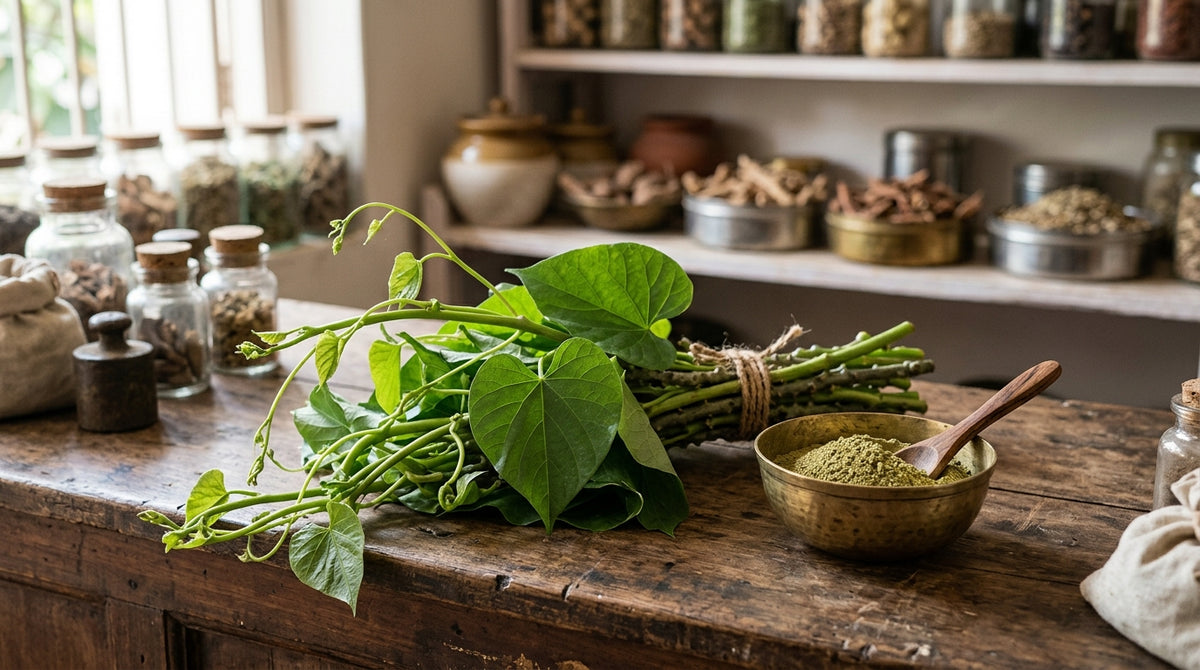
Dhanyawad Ayurved Hadjod Capsule is an Ayurvedic wellness supplement built around Cissus quadrangularis — known in Hindi as Hadjod (हड़जोड़), which literally means "bone joiner." For thousands of years, Ayurvedic practitioners have used this four-angled vine to support fracture recovery, strengthen bones, ease joint discomfort and support cartilage health. The capsule form provides a convenient, measured dose without the need to prepare traditional decoctions. Available in 120-capsule (₹599) and 180-capsule (₹849) packs from Dhanyawad Ayurved, Dwarka. It is a wellness support product — not a treatment for osteoporosis, fractures or any diagnosed bone or joint disease.
- Hadjod (Cissus quadrangularis) is Ayurveda's foremost bone-joining herb — its Sanskrit name Asthisamharaka means "that which prevents the destruction of bones" and classical texts list it first for fracture management.
- Dhanyawad Ayurved Hadjod Capsule is available in 120-capsule (₹599) and 180-capsule (₹849) packs, making it a convenient, measured alternative to raw herb or powder.
- The capsule form delivers a consistent dose of Hadjod extract without the need to prepare a decoction or paste — the traditional preparation method required soaking stems overnight.
- People with diabetes, hormone-sensitive conditions, or those on blood thinners or osteoporosis medication must consult their doctor before use — do not stop prescribed medication.
- Hadjod Capsule supports general wellness of the musculoskeletal system; it is not a treatment for osteoporosis, diagnosed fractures or any bone disease.
What is the Hadjod plant?
Hadjod (Cissus quadrangularis) is a perennial succulent vine native to the tropical and subtropical regions of India, Sri Lanka, Africa and Southeast Asia. It belongs to the grape family (Vitaceae) and is immediately recognisable by its distinctive four-angled (quadrangular) green stems that grow in segments, often with small leaves at the nodes. The plant thrives in warm, dry conditions and can be found climbing walls, fences and trees across peninsular India — from Gujarat and Rajasthan to Karnataka and Tamil Nadu.
In Ayurveda, Hadjod is classified under asthisandhaniya (bone-joining), shothahara (anti-inflammatory) and balya (strengthening) categories. It is listed in classical texts including the Charaka Samhita and Ashtanga Hridayam as the primary herb for bhagna (fracture) management. Phytochemical studies have identified flavonoids, triterpenoids and other active constituents that may contribute to its traditional properties.
| Language / Classification | Name |
|---|---|
| Hindi | हड़जोड़ / Hadjod / Hadjora |
| Sanskrit | Asthisamharaka / Asthishrinkhala / Vajravalli |
| English | Bone Setter / Veldt Grape / Devil's Backbone |
| Botanical name | Cissus quadrangularis L. — Family: Vitaceae |
| Tamil | Pirandai (பிரண்டை) |
| Telugu | Nalleru (నల్లేరు) |
| Marathi | Kandvel / Hadjod |
| Part used | Stem (primary); also leaves and root |
How to identify genuine Hadjod
Adulteration is common in the Hadjod market because several vines have similar growth habits. Genuine Cissus quadrangularis has three reliable identification markers:
- Four-angled stem: Each internode of the stem has four distinct ridges running along its length — this is the defining character. Cross-section of the stem is roughly square.
- Fleshy, jointed segments: The stem is visibly jointed at regular intervals, with a slight narrowing (node) between each segment. The plant looks like it is made of "linked" sections.
- Whitish waxy coating: Fresh stems have a slight whitish bloom on the surface; dried stems are grey-green and lighter than common vine cuttings.
When buying in powder form, genuine Hadjod powder is off-white to pale greenish, with a faintly bitter, slightly astringent taste. If the powder is very dark brown or strongly bitter, it may be mixed with other material. Dhanyawad Ayurved sources whole stems before encapsulation and can show the raw material on request.
Traditional uses: what Hadjod is known for in Ayurveda
Bone healing and fracture recovery
The most celebrated traditional use of Hadjod is in bhagna chikitsa (fracture management). Classical Ayurvedic texts describe a paste of fresh Hadjod stem applied externally to fractured limbs, with the juice also taken internally. The rationale in Ayurveda is that Hadjod nourishes asthi dhatu (bone tissue) directly, accelerating the natural process of callus formation. Modern phytochemical analysis has identified phytosterols and flavonoids in the plant that have been studied for bone-related activity. This is a traditional-use benefit — the capsule supports general bone wellness but is not a treatment for diagnosed fractures, which require professional medical management.
Joint pain and mobility
Hadjod is classified as vata-shamaka (calming to vata dosha) in Ayurveda, and excess vata is the traditional explanation for joint pain, stiffness and cracking in joints. The herb is traditionally used for sandhigata vata (osteoarthritis-like condition in Ayurvedic terminology) — joint pain that worsens in cold and dry weather, with stiffness in the morning. Regular use over 4–8 weeks is considered necessary before assessing benefit. If you have diagnosed arthritis or joint disease, do not stop prescribed medication — speak to your doctor before adding any supplement.
Bone density and healthy ageing
In Ayurvedic rasayana (rejuvenation) practice, Hadjod is considered a Dhatuposhak (tissue-nourishing) herb with a particular affinity for bones and cartilage. It is traditionally recommended for older adults whose asthi dhatu (bone tissue) naturally becomes lighter and more porous with age — corresponding roughly to what modern medicine calls bone density changes. It is also used for children during growth phases and for women after menopause in some traditional formulations. This is supportive, not medical treatment for osteoporosis.
Cartilage and ligament support
Beyond bone, Hadjod is traditionally associated with the health of snayu (ligaments) and sandhi (joint spaces). After sprains, repetitive strain injuries or surgery on joints, Ayurvedic practitioners have used Hadjod as part of post-injury recovery to support the healing environment. Athletes and physically active people use it in the same spirit — not as a cure for injury, but as a traditional tonic for the connective tissues of the musculoskeletal system.
Digestive support (secondary use)
Hadjod has traditionally also been used for digestive complaints including loss of appetite, sluggish digestion and flatulence. The stem is sometimes consumed as a pickle or cooked vegetable in South India (called Pirandai). The digestive benefit is secondary; the capsule formulation is primarily intended for musculoskeletal support.

How to take Dhanyawad Hadjod Capsule
The standard Ayurvedic guidance for Hadjod extract in capsule form is 1–2 capsules twice daily, with warm water or warm milk, preferably after meals. The recommended course length is 8–12 weeks for musculoskeletal support. Do not exceed the stated dose on the label. Children under 12 and pregnant or breastfeeding women should consult a doctor before use.
| Pack / Form | Price | Duration (1 cap twice daily) |
|---|---|---|
| 120 Capsules | ₹599 | 60 days |
| 180 Capsules | ₹849 | 90 days |
Buy Dhanyawad Ayurved Hadjod Capsule: Hadjod Capsule – 120 caps ₹599 / 180 caps ₹849. Available at Dhanyawad Ayurved Vatika, Dwarka, Delhi, and shipped across India.
Capsule vs raw herb vs powder: which form suits you?
| Form | Convenience | Dose accuracy | Traditional preparation | Best for |
|---|---|---|---|---|
| Capsule | High — no preparation | Precise | Modern; standardised extract | Daily consistent use, busy schedules |
| Stem powder | Medium — mix in water/milk | Moderate | Close to classical use | Those who prefer traditional methods |
| Fresh stem / juice | Low — requires plant access | Variable | Classical (paste + juice) | Traditional practitioners with plant access |
| Decoction (kwath) | Low — 20 min preparation | Variable | Classical, most bioavailable | Ayurvedic practitioner-guided use |
The capsule is the most practical form for people who want consistent daily use. For more on the general herb profile, benefits and identification, read our detailed herb guide: Hadjod Benefits – Complete Guide.
Who should be cautious and when to see a doctor
Hadjod is generally well-tolerated as a traditional Ayurvedic herb. However, the following people should consult their doctor or an Ayurvedic practitioner before starting Hadjod Capsule:
- People with diabetes: Hadjod may influence blood sugar — monitor levels carefully and do not adjust your diabetes medication without medical supervision.
- People on blood-thinning medication (warfarin, aspirin, clopidogrel): Hadjod contains compounds that may affect blood clotting. Tell your doctor about all supplements you take.
- People with hormone-sensitive conditions (some breast, ovarian or uterine conditions, hormone therapy): Hadjod contains minor phytosterols; discuss with your specialist.
- Pregnant and breastfeeding women: Safety in pregnancy is not established — do not use without medical guidance.
- Post-surgical patients: Consult your surgeon before taking any supplement after bone or joint surgery.
See a doctor immediately if you experience: sudden severe joint pain or swelling, inability to bear weight on a limb, signs of fracture (deformity, crepitus), unexplained bone pain at night, or any allergic reaction (rash, swelling, difficulty breathing) after taking the capsule.
Read the companion guide for the raw herb: Hadjod (Cissus quadrangularis) – Herb Profile.
Frequently Asked Questions
What is Hadjod and what does it do?
Hadjod (Cissus quadrangularis) is a four-angled succulent vine used in Ayurveda for over 2,000 years to support bone healing and joint health. Its Hindi name literally means "bone joiner." It is traditionally used for fracture recovery, bone strength, joint pain and cartilage support. The Dhanyawad Hadjod Capsule delivers its extract in a convenient, measured form.
How long should I take Hadjod Capsule?
Traditional Ayurvedic practice recommends a minimum course of 8–12 weeks for musculoskeletal support. Effects are gradual — unlike pain medications, Ayurvedic tonics work by supporting tissue nutrition over time. After the initial course, some people continue at a maintenance dose of one capsule daily. Consult an Ayurvedic practitioner for personalised guidance.
Can I take Hadjod Capsule with other medicines?
Hadjod may interact with blood-thinning medications, diabetes drugs and hormone therapies. Always inform your doctor about all supplements you take. As a general rule, leave a 1–2 hour gap between pharmaceutical medicines and herbal supplements. Do not stop any prescribed medication without medical advice.
Is Hadjod safe for women?
Hadjod is traditionally used by both men and women for bone and joint health. Women going through menopause, who are at higher risk of bone density changes, often use it as a traditional support supplement. However, pregnant and breastfeeding women should not use Hadjod without first consulting their gynaecologist, as safety in pregnancy has not been established.
What is the difference between Hadjod raw herb and Hadjod Capsule?
Both deliver the same active compounds from Cissus quadrangularis. The raw herb (stem) can be juiced, made into a paste, or dried and powdered — these are the traditional preparations. The capsule contains a standardised extract of the herb in a fixed, convenient dose, with no preparation needed. For people without access to fresh plants or time for decoctions, the capsule is the practical modern equivalent.
How do I store Hadjod Capsule?
Store in a cool, dry place away from direct sunlight and moisture. Keep the bottle tightly closed and out of reach of children. Do not store in a bathroom or near the kitchen stove. The capsule shelf life is printed on the pack — do not use beyond the expiry date.
Where can I find the Hadjod plant in India?
The Hadjod plant (Cissus quadrangularis) grows wild across peninsular India — particularly in Gujarat, Rajasthan, Karnataka and Tamil Nadu — where it climbs walls and fences in warm, dry conditions. It is also cultivated in kitchen gardens in South India (known as Pirandai in Tamil). If you cannot access the fresh plant, Dhanyawad Ayurved Hadjod Capsule provides the same herb in a convenient, measured extract form — available online and at our Dwarka store.
How do you use Hadjod leaves?
Hadjod leaves are less commonly used than the stem. Some traditional formulations use fresh leaves as a poultice applied externally around fractured or sprained joints. The leaves can also be cooked as a vegetable in South Indian cuisine (similar to how the stem is used as Pirandai). For consistent daily supplementation, the stem extract in capsule form is more practical than preparing fresh leaves — which requires plant access and preparation time.
Sources
Written by the Dhanyawad Ayurved team and reviewed by Vaidya Ravinder Arora (40+ years), Dhanyawad Ayurved Vatika, Dwarka, New Delhi. This article describes traditional uses for general information. It is not medical advice. Consult a qualified doctor or Ayurvedic practitioner before using any herb therapeutically.

